
Chamoru Cultural Assimilation – Collapse or Continuity?
Posted by - frinkt
Chamoru Cultural Assimilation: Collapse or Continuity?
Introduction
The arrival of a half dozen Spanish Jesuit missionaries and a small band of lay volunteers in 1668 marked the beginning of the first intense contact between the Chamoru people of the Mariana Islands and Spain. Spanish ships had been visiting the islands for a century and half before the arrival of the missionaries, but the visits had been brief although sometimes violent, but without lasting impact on the people and their way of life. The missionary party that arrived in 1668, however, came to stay. During the chaotic thirty years that followed, frequent hostilities took place, lethal epidemics were unleashed by the Europeans, and great loss of life occurred throughout the island group. Before long, the population had suffered a disastrous decline and whole villages were relocated. Nearly all of the surviving island people were baptized and subject to the strictures of the new religion. But what, if anything, remained of the old cultural beliefs and ways? Was the traditional culture itself extinguished, another casualty of Spanish colonization?
Today the people of this island society trace their descent to those figures portrayed on public monuments: robust, scantily clad ancestors with hair in topknots and spears in hand. They are presented in the drawings of 19th Century European visitors as skilled sea-voyagers who moved easily from one island to another and drew upon the sea for their sustenance. Always there is an air of freedom in the way they are represented. Then, of course, there are the latte stone remains that testify to the pride and achievement of these early people. These are the enduring images of what this people must have been, even if their dances, songs and much of their traditional lore has been lost to us today.
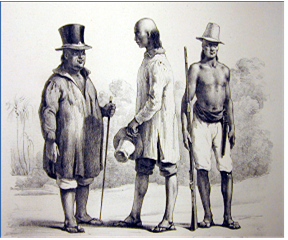
How do these early ancestors, largely unaffected by Western society, relate to the people depicted in another set of familiar drawings from the 19th Century? The same Russian and French naval parties who painted the romantic view of life before European influence offer a far more sober glimpse of people who are by then settled in villages, the women wearing shawls and men dressed in trousers and occasionally with a top hat. They are represented as a people living in the shadow of a stone church that seems to encompass much of their life. These are a devout people, entering church for their devotions and ceasing work in the fields to pray the Angelus.
What is the cultural link between the two generations of islanders represented in these European drawings? For that matter, we might ask what Chamoru people today have in common with their early ancestors other than language and genes, both of which have been greatly altered over the years.
What traces do we find of Chamoru pre-contact culture once islanders began their settled life in village centers under Spanish rule? Must we mourn a cultural collapse? Or is there a cultural continuity to be found here?
That is the theme of this booklet. Let me assure you from the outset that although I will make liberal use of the Spanish documents that describe the way of life on these islands before and after Spanish contact, I’ll be trying to read between the lines, as I used to tell my studentsBthat is, to make inferences from written sources on what really happened and why. Moreover, I shall be drawing on my understanding of neighboring Micronesian societies to present a clearer picture of what, for instance, the matrilineal system and men’s houses may have meant in practice for the people of the Marianas.
Cultural Gap as Viewed by 19th Century European Visitors
Illustration #1
AFTER….
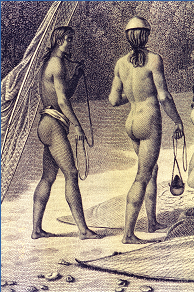
BEFORE….
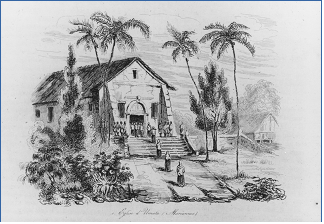
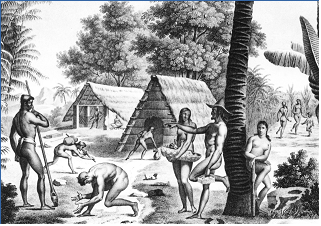
The Setting
By 1700 the period of intermittent violence in the islands over the previous 30 years had ended. The population of Guam, once distributed throughout well over a hundred settlements, was concentrated in a handful of villages, even as the people of all the northern islands, with the exception of Rota and Saipan, were resettled on Guam. (Saipan, too, would be evacuated by the early 1730s and its people transported to Guam.) The movement of the population into villages where they could be more easily catechized by the priests and provided with religious devotions was a Spanish strategy known as reduccion. The concentration of the people of the Marianas into a few villages, each with a church and a pastor, is generally looked upon as a turning point in the history of the island group: a mark of local people’s submission to Spanish colonial and cultural domination.
Table 1 – Village Population Figures: 1690-1741
|
Year |
Hagatña |
Pago |
Umatac |
Agat |
Fina |
Merizo |
Umatac |
|
1690 |
300 |
200 |
180 |
300 |
200 |
||
|
1693 |
449 |
155 |
370 |
249 |
154 |
254 |
|
|
1696 |
746 |
180 |
192 |
275 |
177 |
139 |
|
|
1710 |
901 |
404 |
318 |
516 |
437 |
496 |
|
|
1727 |
752 |
214 |
209 |
343 |
256 |
198 |
|
|
1731 |
756 |
204 |
181 |
329 |
236 |
209 |
|
|
1738 |
650 |
142 |
192 |
275 |
159 |
133 |
|
|
1741 |
622 |
155 |
153 |
259 |
203 |
184 |
Figures for 1690 are from Fr. José Hernandez, letter of 1690; published in Abella 1962: 42-5.
Figures for 1693 are found in Fr. Magino Sola, 1693; published in Repetti 1940a..
Figures for 1696 appear in ARSJ, Filipinas 14.
Figures for the remaining years are taken from Freycinet 1839: 331-3.
The Chamoru people, by the early 1700s, had been reduced in both senses of this word. The number of inhabitants, estimated at perhaps 40,000 before the arrival of the Spanish missionaries, plummeted to less than 4,000, according to the 1710 census. During the turbulent times following the arrival of the Spanish, perhaps 200 lives, on both sides, were lost in sporadic hostilities during the final three decades of the previous century. But the loss of life in battle was dwarfed by the toll taken by the diseases unwittingly introduced to the islands. Violence claimed the lives of four islanders and two or three foreigners each year during this period. In the year 1700 alone, by contrast, 650 islanders died in a single influenza epidemic.[i] The end of hostilities certainly did very little to stem the loss of population, as we know from contemporary accounts: during the initial five-year period after the resumption of peace (1698-1702) waves of infectious disease claimed 3,000 lives.[ii] Table 1 above offers a glimpse at the staggering death count for select years during the early resettlement period.
The steep decline in population, we might add, affected males and females equally. The numbers in the 1727 census show no significant gender disparity.[iii] Hence, there is no evidence to support the old myth that Chamoru males were killed off in the wars, as authors sometimes maintain. Saipan in 1696 is the single exception, with 579 women and only 284 men; but this can be explained by the instability of the island population at that time and the departure of many young men to other places.[iv] Otherwise, the remaining population of the Marianas was evenly distributed by gender.
The arrival of Fr. Diego Luis de San Vitores and his missionary party at Hagatña, Guam, in June 1668 initiated the first sustained contact between the islands, which the Jesuit priest renamed the Marianas, and the Western world. The six Jesuits and their 31 lay volunteers, including two women, a couple of 12-year-old boys, and a 60-year-old retired craftsman, were a rag-tag team of Filipinos and Mexican half-castes picked for their religious piety and useful skills.[v] Without weapons other than a few old swords, some bows and arrows, and a musket or two, they presented a vulnerable target as they moved around the island to bring their religious message to the people. The islanders could have easily eliminated them if they had decided to do so. The missionary party had no military protection other than what they themselves could provide with the weapons they had at hand.[vi] Only in 1675 did the first Spanish troops arrive, if indeed they could be called troops. (Some of the later Jesuits had serious doubts on the matter, referring to them as no better than criminals from Mexico… Spaniards in name only, but in fact cowardly, spoiled and good for very little.).[vii] In any case, most of the troops who were not shipped out to Manila eventually married local women and, as custom dictated, became beholden to their Chamoru in-laws.
From the very beginning the island people, who had never been united under a single head, were divided in their response to this band of outsiders. Just after coming ashore, the missionary party received a warm welcome from Kipuha, the village chief of Hagatña, and was hosted at a feast attended by chiefs of other nearby villages. The Jesuits and their helpers were invited to reside and work in Hagatña as they carried out their evangelization of the island. In the years to come, this village and its environs would produce some of the strongest supporters of the mission: men like Antonio Ayhi from Hagatña and Ignacio Hineti from Sinajana, who fought to protect the missionaries and to avenge casualties inflicted on them. True, Hagatña itself had briefly turned against the foreigners on two occasions during these early years, in 1671 and in 1676, but these were perhaps more angry demonstrations at perceived insults than campaigns intent on wiping out the missionary party.[viii] Generally the newcomers could expect support from the people of that village, the largest and the most prestigious on the island at that time.
Other villages were not at all receptive to the missionary band. In a number of instances, the missionaries had somehow offended a prominent figure or angered people over their callous disregard of cultural practices. In other cases, the unreceptive villages were simply aligned against Hagatña, as well as against all those perceived to be under the influence of Hagatña. Over the years, hostile incidents multiplied, sometimes on one part of the island, sometimes on another, as divisions between the missionary supporters and their enemies hardened. Chochogo, located near present-day Toto, was the scene of a few killings and became known as a rallying place for those opposed to the Spanish. Nisichan, situated in today’s Mangilao, was another village known for its resistance to the missionaries.[ix] Sidia and Ati, both near Umatac; Talofofo and nearby Pigpug; Tarragui and neighboring Hanum in the north were other settlements with a reputation for hostility to the missionaries.[x] Yet, overall, baptisms continued, and Christians grew in number.
The early mission period was an explosive time, literally and figuratively. Those early years of intensive contact with the West introduced the island people to new material objects (tools, cloth, and so much more), new belief systems (chiefly Christianity), and new behavioral practices (covering everything from birth to burial). But the period also brought new demands (mostly imposed by outsiders), new causes of contention (especially the divided reaction to the new religion) and new means of settling these quarrels (muskets fired in a full-out fight). Doing battle when contention arose was no new thing in the islands, but the cultural chasm between islanders and outsiders offered hundreds of new reasons to fight. And fights started again and again during those early years of intensive contact.
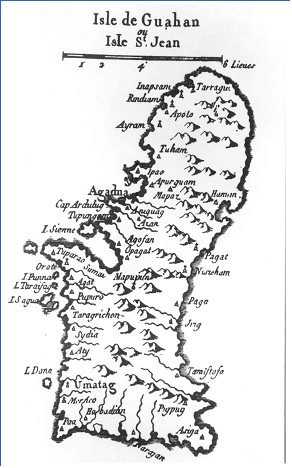
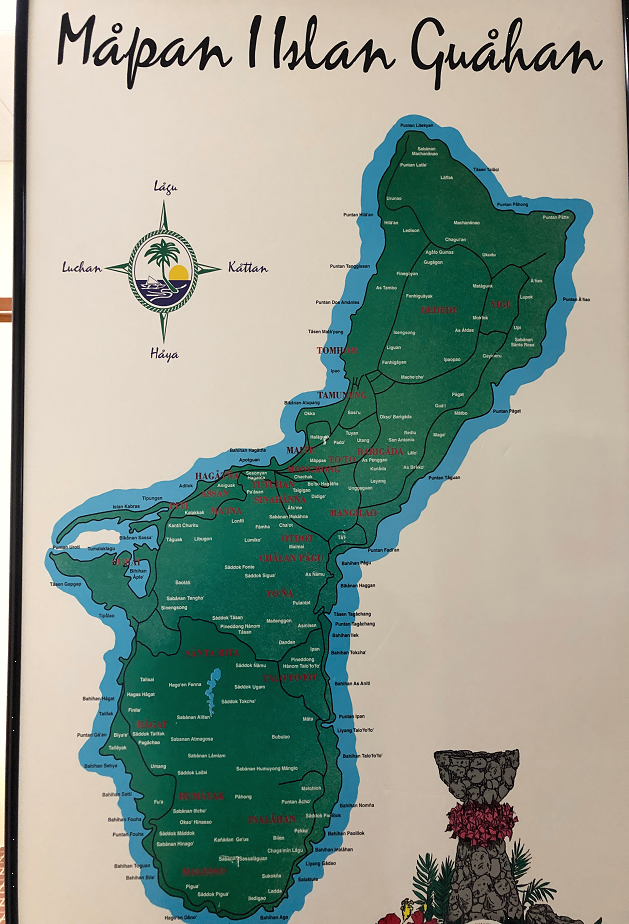
| Illustration #2 Early Map of Guam with Key Villages Marked |
Illustration #3 Map of Guam showing the key major villages marked, presented section by section, according to the text. (Carlos Madrid’s map) |
The missionaries may have scoffed at the Chamoru complaint that outsiders had unleashed a plague upon their islands. One of them wrote scornfully about their local critics: They affirm that our ships, by sailing through their lands, brought rats, flies, mosquitoes, and all their diseases. And they prove their statements about diseases: after ships have been in the islands, they have colds and other illnesses.[xi] Yet, the scourges were real and the attribution of them to the visiting Spanish ships is correct, as we know today. Why, then, would islanders, who knew what was at stake, crowd the shore whenever one of these ships put into port? As the same author noted, As long as the ships are in port, they never leave the shore, either day or night, in the sun or in inclement weather. He blamed the island people’s greed for iron and other trifles for their willingness to take such risks.[xii]
To view the missionary arrival as nothing more than an unwanted intrusion into the islands is to misread history. The Spanish missionary party may have antagonized islanders at times, even to the point of inciting violence, but they also brought luxury goods with them and the promise of more to come. The iron hoop they distributed when they first disembarked from their ship in 1668 was just a teaser. The Spanish provided iron axes and adzes as tools, cloth for weaving, corn and other crops for planting, and animals like cows and pigs for breeding. Moreover, the religious practices and beliefs the missionaries encouraged islanders to adopt seem to have resonated with many of them much more than we might have imagined. One young man from Saipan, for instance, voluntarily explained his decision to leave family and home to live on Guam as a decision made with an eye to his salvation.[xiii] Whatever the motives may have been, baptisms occurred with ever greater frequency. Before long, most of the settled population was baptized and many seemed to enthusiastically embrace the new religion. Overall, we must conclude, the newcomers offered numerous attractions, material and spiritual, to the islanders.
By 1700, then, the majority of the surviving island population had become Catholic. No doubt some reluctantly consented to baptism out of fear, but many others seemed to find satisfaction in the new religion. Five of the prominent village chiefs on the island, after all, had fought at the side of the Spanish party in conflicts with other villages. Even those who may not have really wanted to participate in the new Catholic village life may have recognized the wisdom in becoming a part of what looked like the wave of the future.
So, by the turn of the century, nearly all the Chamoru people were converted and living within sound of the village church bells. The cultural war, as some might imagine it, was over. Those who had survived the terrible epidemics resumed their lives in a society that had been markedly changed in a short period of time. They found themselves challenged by a European system, political, religious and commercial, that greatly differed from their indigenous system. How did their culture fare after this onslaught? Did the local people simply abandon it in favor of an imposed alternative and let it perish altogether?
Many people today seem to assume that the survivors of the early contentious period were forced to turn their back on their former cultural ways in the end. If this was the case, we can expect no more than an entire disconnect between the pre-contact culture of the Marianas and cultural life today. In other words, the culture suffered the same fate as the population itself, that is, near-extinction.
But perhaps the outcome wasn’t a matter of simply cultural survival or extinction. Traditional cultural characteristics might have been embedded in new forms. Even in the course of a major cultural transformation such as occurred during this period, we might ask what, if any, recognizable features of the old culture remained after the assimilation with Spanish ways.
In posing this question, we will use Guam as a focal point for examining this question of cultural survival, since most of the population of the Marianas was resettled there by 1700. On that island, moreover, the influence of the Spanish Catholic culture was far stronger than anywhere else in the island group. Consequently, the documentation of the new lifestyle would be far richer for Guam.
The Social Landscape
Island Network of Villages
Guam’s population at the arrival of the Spanish was, according to one mission account, distributed throughout 180 villages.[xiv] The villages did not seem to be formally ranked, but their prestige probably varied according to earliest settlement and the importance of the clan that ruled the village. This was certainly the case in other parts of the Pacific. Although we know nothing at all of the village history on Guam prior to European contact, we may assume that the more important villages were located on the coast (the most desirable setting for a people who depended so heavily on the sea for their sustenance), while the less important villages were those situated inland.
The difference in prestige among the villages seems to be the foundation for the missionaries’ belief that there were two or three different classes in pre-contact Chamoru society. Fr. Peter Coomans, for instance, writes that all the people are divided into classes. Those who live along the shore are held to be the nobles… The hill people are of an inferior class and of humble blood.[xv] Rather than view this as evidence of a caste system, something most unlikely in an unstratified society, we might see this as suggesting that the choice villages along the shore were under the control of the clans that had established themselves earlier than others, or that had displaced those that had been there even earlier.[xvi]
There is no evidence whatsoever for any authority beyond that of village chief; the island was politically fragmented. The Spanish missionaries could report: Neither the islands taken altogether nor the individual villages have a head who governs the others.[xvii] This statement is supported by everything else that we know of the early villages. Village chief was probably the highest authority position on the island; there do not seem to have been sectional chiefs (as in Palau or Yap), much less the paramount chief so common in Polynesia. Consequently, any village chief with a conflict to resolve would have had to depend on alliances with other village chiefs (as was true in Chuuk and the atolls throughout the Central Carolines).
Crosscutting relationships with others throughout the island were a strong feature of life on Guam, as they were in other island groups. A resident of Hagatña might have marriage ties with people from several villages, not to mention clan mates and perhaps even lineage mates elsewhere. These relationships were always the practical starting point for establishing alliances between villages on the island. Indeed, leaders of the anti-Spanish movement like Hurao and Aguarin had to move around the island selling other village chiefs on their intention to resist the missionary party, as the documents make clear.
Authority within the Village
Chamoru society was clearly matrilineal, as the early sources make clear even if they don’t use that word.[xviii] This means that Chamorus traced their descent primarily through the mother’s side of the family rather than through the father’s. All of a woman’s children, whether male or female, were considered part of her lineage, just as all her daughter’s children were of the same lineage group. (Her son’s children, on the other hand, were considered part of a different lineage, that of their own mother.)[xix] In this system, the highest ranking matrilineage, usually the one regarded as having the earliest rights to the village land and thus enjoying traditional authority in the place, was entitled to rule the village. It is not the son of the deceased who inherits his father’s estate, but rather the brother or the nephew of the deceased, one Spanish source notes with surprise.[xx]
The matrilineal descent line guaranteed women a strong voice in the life of family and the village, even if the chief was almost always a man, perhaps the brother of the oldest living woman in the matrilineal line. The chief might have served as the spokesperson, but the decision rested with the women.
The earliest Spanish documents bear this out. Women’s authority in the household was so pronounced, one priest relates, that young girls who intended to marry Filipino or Mexican soldiers had to be taught to obey their husband. In the house of their parents the girls were used to seeing that the head of the household was the woman, the priest explained.[xxi]
Not only was descent reckoned through the mother’s side of the family, but the mother’s lineage was often concentrated in a single village. When girls married, they usually brought their husbands to live with them on their own family estate. In other words, Chamoru society was not only matrilineal, but matrilocal as well. This was a common feature of traditional Micronesian societies in the Central Carolines, Chuuk, and probably Pohnpei at one time. In those cultures as in the Marianas, men may have assumed the role of chief, but the decisions were made largely by older women within the lineage.
With a woman and her husband usually residing in her own village, the couple would necessarily live under the watchful eye of her family and the authority of the matrilineal chief. In such a system it is understandable why men would be punished so much more severely for infidelity than women, as the letters from this period attest.[xxii]
As men from other places married into the village, other matrilineages might gradually become established in the village, but the latter remained subordinate to the ranking lineage and its chief. If the system operated as it did in other Pacific islands, these subordinate groups would have been obliged to show respect to the chief, perhaps by offering periodical tribute to him, usually in the form of first fruits, as a recognition of the authority he held in the village. After all, the men marrying into the village were living on land that was the domain of their wife’s lineage. Yet, these married men were still bound by strong ties to their own lineage. As a result, the village chief commanded their respect but not their total submission. This may well have been the reason that village chiefs were seen as holding limited authority over their own villagers.[xxiii]
We can conclude, then, that the image of the traditional village chief as magalahi, as many visualize it today, is little more than a fantasy.
Redrawing the Map of the Island
The 180 original villages of Guam ranged in size from inland hamlets of five or ten scattered houses to coastal villages of as many as 80 or 100 buildings.[xxiv] We can suppose that most of those 180 villages would have been nothing more than hamlets containing just a few families, with perhaps a dozen villages being considerably larger and Hagatna one of the largest.[xxv] As the population dwindled during the early mission period, some of the smaller settlements must have simply disappeared.
The impact of the Spanish, of course, also had a hand in the fate of the villages even before the first reduccion was put into effect in 1680. Here we will review what we know of the major villages in each section of the island.
North
Tarragui, at the time of Saravia’s first reduction, was probably the biggest settlement in northern Guam: described as the capital of this side of the island, a town of 76 houses.[xxvi] Ritidian seems to have been only slightly smaller village. At first, the missionaries regarded the northern part of the island as too dangerous to visit, but soon they were making regular visits to both of these villages, each with its own church.
In a new outbreak of violence in the mid-1670s, two Jesuits and a few mission volunteers were killed there. During the next ten years both gained the reputation as centers of resistance against the Spanish, Tarragui when it offered refuge for Aguarin, the leader of the 1676 assault on Hagatña, and Ritidian when it provided support for Yura during the siege of Hagatña in 1684.[xxvii] Despite the number of baptized in these villages, neither was secure enough to serve as a population center under the new administration.
The other villages in the north were no more reliable. Inapsan, another one of the bigger villages, was burned by the Spanish and its people moved into Ritidian.[xxviii] Hanum, another bastion of resistance, was attacked by Spanish troops in 1679 and was the scene of a battle described as the fiercest that had yet taken place in the Marianas.[xxix] Both were shut down and their people moved during the reduction. Consequently, the north was left without a recognized resettlement village.
East Coast
The east coast was rather hostile to the missionaries. Nisichan (Mangilao) and Talofofo were once large villages, but both were also famed refuges for those who opposed the missionaries. Pago, situated on a large bay, was the one place that was reasonably friendly, and so it was selected as one of the villages for resettlement.
Further down the coast, Talofofo had a suitable location but was viewed as a rebel stronghold. The nearby village of Mapupan, which had a church that served the surrounding area, was designated one of the resettlement villages in 1680, but the parish was closed just a few years later. Afterwards, Pago remained as the only major village in this area.
Northwest Coast
Ayraan, located in what is now Dededo, was an early mission station, but the church there was set on fire during an uprising in 1676.[xxx] The other large village was Tumhon (present day Tumon), the site of Fr. San Vitores’ killing. Since both were troubled villages, neither was selected as the resettlement center for this part of the island. In addition, the population of both villages was dropping as more people moved down to Hagatña to take advantage of what the growing town had to offer. By 1680, Hagatña and its environs had became the most populous part of the island.
Southwest Coast
In the early missionary letters, we are told that Aguarin, one of the best-known leaders of the resistance, used his influence to draw to his side the most distant villages… of Tarisay, Orote, Fuuna, Sumay and Agofan.[xxxi] Residents of each of these villages, among the most prominent of the area, had been punished because of their role in early clashes with the Spanish. The only village of any size left was Agat, which was chosen to be another of the resettlement villages on Guam.
South
Three good-sized villages were already established in the southern end of the island, the most populous and fertile section of Guam. Umatac, by 1680, was probably the most important village after Hagatña, thanks to its location next to the bay at which the Spanish galleon made its yearly layover. Fena, an interior settlement located in a valley between Agat and Talofofo, was selected as a second village in the south. During the following two decades, however, most of its inhabitants drifted off to one of the other coastal villages in the south.
Both Merizo and Inarajan, on the other hand, enjoyed favorable locations on the coast, and the population of both increased significantly as resettled people from the northern islands were resettled on Guam. Moreover, the missionaries generally seemed comfortable in traveling to this part of the island, notwithstanding the hostility shown in other places. By 1700, Merizo and Inarajan along with Umatac came to be numbered among the official resettlement centers of the island.[xxxii]
Establishment of Select Villages
The concentration of the population (or reduccion) into well-defined villages is often understood as nothing more than a tool of more effective colonization. Although that purpose can not be totally discounted, its rationale rests much more in the christianization of the island population, a goal which, however neglected at times by the administration, was reaffirmed again and again in Spanish royal documents as the main purpose of the original Spanish venture in 1668. The assumption of the Spanish missionaries, in these islands as in other mission fields, was that merely baptizing non-believers and expecting them to sustain their faith in isolation was to leave their work half-done. Just as important as the initial evangelization was the establishment of what they would have called cristianidad, a faith community that would have provided the support needed to sustain the belief of these converts. The community, of course, was modeled on Spanish towns. But that model was subject to change as islanders adapted it to their own cultural features over time. The new village, as one recent author put it, became the transactional context … where the possibility existed to mix traditional and new elements.[xxxiii]
The first attempts to resettle the Guam population date back to 1680, just twelve years after the missionaries landed, when Governor Saravia proposed concentrating the population into seven pueblos, or villages. After the early tumultuous years, Saravia initiated an interlude of peace in the Marianas during his brief tenure as governor. His treatment of local people was gentle and conciliatory. Even though Saravia’s men torched the abandoned houses in outlying areas, this early reduccion was effected without major protest because of the real enticements to living in one of the major villages.[xxxiv] Among the attractions were the new array of crops and animals, as well as the relative ease of procuring trade items (mainly tools, tobacco, and cloth). For those who had already converted to Christianity, there was the added appeal of living within easy reach of the church.
The norms used for selecting the main villages to serve as population centers were simple and few. Only the few larger villages on the island, most of which were readily accessible by land and sea, would be considered. Such villages would have numbered not more than a dozen or so even before the coming of the Spanish and the rapid population decline. Some of the larger villages had to be ruled out because of their resistance to Spanish influence and overt hostility to the missionaries, as we have seen. Accordingly, in 1680 Saravia chose seven villages as recognized population centers and sites for a parish.[xxxv]
By the turn of the century, the seven villages were reduced to six when Fena no longer registered any inhabitants; its people had moved to the nearby villages of Pago and Agat. The six remaining villages were Hagatña, Pago, Umatac, Agat, Merizo and Inarajan. The population of these villages ranged between 318 (Umatac) and 901 (Hagatña). In 1710, the year of the first census, the population of Guam was counted at 3,072.[xxxvi] Most of the island people were living in one of the six villages by then, even if a small number may have gone off into the interior to live on their own.[xxxvii]
Only two other islands in the Marianas were still populated after the turn of the century: Rota and Saipan. Saipan’s population would decrease so quickly that by 1731 the church was closed and all missionary work there ended. Rota had a population of 467, according to the 1710 census, but by the next census, in 1722, the number dropped by nearly half to 240. The island population would remain at between 200 and 300 for the rest of the century.[xxxviii]
As those from outlying areas moved into the villages, their size remained manageable because of the overall population decline during this period. The population figures spiked sharply in 1710, doubling after the resettlement of those from the islands in the northern part of the chain, but by 1727 the numbers had fallen to what they had been formerly, an average of 200 or 300 per village with the exception of Hagatña.[xxxix]
Table 2 — The Toll of Disease: Births and Deaths in the Marianas, Select Years
|
Year |
Live Births |
Deaths |
Net Loss |
|
1689 |
166 |
? |
|
|
1697 |
521 |
371 |
(+150) |
|
1698 |
436 |
644 |
208 |
|
1700 |
202 |
651 |
449 |
|
1701 |
265 |
500 |
235 |
|
1702 |
236 |
517 |
281 |
|
1708 |
167 |
400 |
233 |
|
1714 |
219 |
328 |
109 |
1689 figures: Fr. Lorenzo Bustillo, annual report 1689-1690; ARSJ Filipinas 14, ff 75-83
1697 figures: anonymous, report for 1698; RAH Cortes 567, leg 12.
1698 figures: anonymous, subjects for annual report, 1699; ARSJ Filipinas 14, ff 92-3
1700 figures: anonymous, annual report in 1701; RAH Cortes 567, leg 12
1701 figures: anonymous, annual report in 1702; ARSJ Filipinas 14, ff 94-5
1702 figures: anonymous, annual report in 1703; ARSJ Filipinas 14, ff 71-3
1708 figures: Fr. Johann Tilpe, annual report in 1709; ARSJ Filipinas 14, ff 97-9
1714 figures: Fr. Filippo Muscati, annual report in 1715; ARSJ Filipinas 14, ff 104-5
When people from nearby hamlets moved into the main pueblos, we may suppose that they made arrangements for land with their own matrilineal relatives. Even if the shape of the villages had been altered, the social organization system founded on blood ties was largely unchanged. The villages, along with their land apportionment, remained matrilineal. In fact, the Spanish laid out sections, called partidos, that embraced the main village along with its surrounding land. The partidos did not always correspond exactly with the old political divisions, but this innovation had no discernible impact on the traditional land inheritance system. But even if the resettlement, with its shuffling of people from one village to another, may not have affected land ownership, it made the job of the village chief much more difficult, as we shall see.
The population of the villages remained almost entirely Chamoru, since Spaniards were not welcome to settle in the villages. The Laws of the Indies permitted Spaniards to conduct business there during the day, but only on the condition that they were out of the village by nightfall. They
and their spouses were obliged to reside in Hagatña, the capital and government center. (Source?) Some of the foreign troops who had married Chamorro women might have lived in the villages for a time, but by the early 1700s the records show no foreign-born persons residing in any of the villages other than Hagatña and Umatac. (Source?) During the following two decades, a few made their way back into the smaller villages. According to the 1728 census, Umatac had four Filipinos, Pago three, Agat two, and Merizo one mestizo and one black man. Hagatña, as might be expected, had dozens of Filipinos and Mexican creoles among its residents; but the population of all the other villages on Guam was overwhelmingly local .[xl]
The Appearance of the New Village
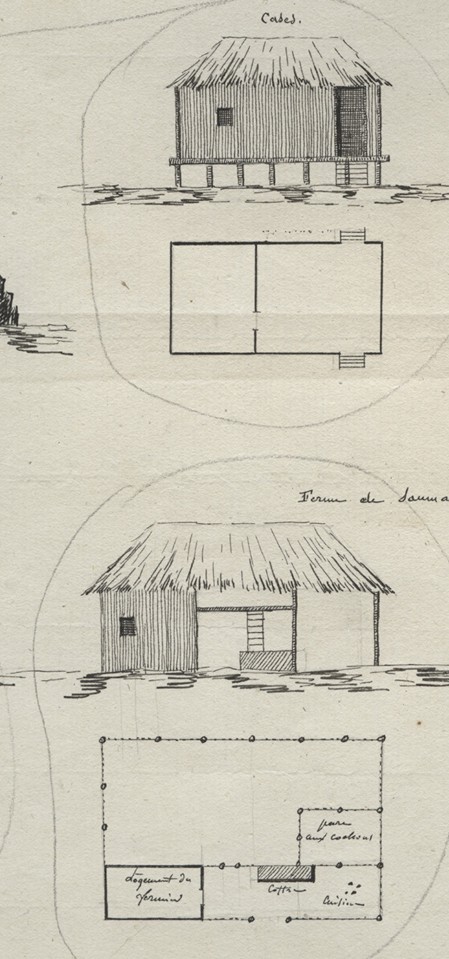
Illustration #4 Drawings of different traditional buildings from Freycinet (Farrell history, p 64-5 — Use pictures from Farrell’s history, pp. 64-5—copies from photos at CNMI Museum)
Now that we have considered the distribution of the island population as affected by the reduction, let us examine the layout of the typical village itself in the 1700s. As we do so, we might have to remind ourselves that those illustrations of village life most familiar to us, the drawings done during French and Russian naval visits, date from the early 1800s, a century after the period we are describing here. Many of the structures and features of life these images represent so vividly reflect changes that occurred over time.
Nonetheless, the concentration of the population by the early 1700s did bring changes to the appearance of the village. As early as 1682, at the direction of the Spanish, some of the homes scattered at random along the shore were being rebuilt in the heart of the village. These houses and those of the people recently resettled from the outlying hamlets were increasingly laid out in orderly rows.[xli] Roads, too, were being enlarged and straightened by Governor Saravia’s work crews and a rectangular layout seemed to be the plan for the ideal village.
There were changes, too, in the structures found in these villages. One major change was the addition of the village church, with a rectory and cemetery, something that we will explore later. Significant, however, was the absence of the standard municipio (mayor’s office) that was normally to be found across from the church in Spanish colonies. There was no need for one, since the traditional chief was expected to provide leadership for the village. But that would change in time.
Clubhouses (so-called urritaos houses) were no longer a feature of the village. They had been destroyed by this time at the insistence of the missionaries because of their association with prostitution. In fact, the sources tell us that on Guam 30 bachelors houses were torn down in a single year (1679).[xlii] By that time, just eleven years after the arrival of the missionaries, a total of 60 bachelors houses had been destroyed.[xliii] Still, the clubhouses were not integral to family life in the village. Village life went on without them just as it did in Palau and Yap when clubhouses were eliminated there two centuries later. In any case, the elimination of the clubhouses never seemed to provoke the angry response from island people that the destruction of ancestral skulls had once produced.
Family buildings continued to be built with local materials, although some modifications, based on the availability of materials, were made in time. The cookhouse, originally a small hut covering a fireplace, was used to prepare the food that would be distributed to the small families that made up the lineage group.[xliv] In time it was modified so that a stone oven could be built above ground to prepare tortillas and roast new foods. The family dwelling house was a longer building than the latte stone hut, long enough to accommodate all the members of the extended family. People slept on plaited coconut leaf mats, the same type that were sometimes hung around the side of the building to protect those within.[xlv] The large canoe houses near the shore also remained largely unaffected by the resettlement, it seems.
None of the celebrated giant latte stone structures were built after the reduction, the construction of these had ceased centuries before, but neither were the old ones destroyed. (Source?). Families that had owned these structures presumably retained their rights to them and depended on them to signify status, as they always had. According to one of the early missionaries, the latte stone houses served as dwellings for some families, but they also had an even more important function. The priest observed that people keep their belongings in… a structure built high upon pillar-like stones. Here are found all their riches, such as some tortoise shell,… a double-edged axe, discolored glass beads, and some castanets.[xlvi] In other words, the latte stone structure, whatever other purposes it may have served, provided an attic storage vault for family treasures.
Family life must have remained much as it had before, with nuclear families clustered in lineage groups on matrilineal land parcels. The roads may have been widened and straightened, a church and rectory built in the center of town, and clubhouses closed, but we can suppose that the family unit functioned much as it always had.
Life in the New Village
Making a Living
When an early form of the reduction was first presented in the 1670s to the people living close to Hagatña, some of them were strongly opposed to moving into the village. What finally made the resettlement more acceptable to them was learning that they could retain rights to their family land outside the village.[xlvii] Family movement between their home and another land parcel over which they held rights was probably an age-old practice in the Marianas, just as it was in other parts of Micronesia. In island land tenure systems, family land parcels were often scattered over a wide area. After the resettlement on Guam in the early 1700s, this back and forth movement would have increased, especially for families who had moved into the village from outlying areas. These families continued to split their time between their residence in the village and their ranch (lanchu), a practice that would be a standard feature of life in the Marianas for the next two centuries or longer.
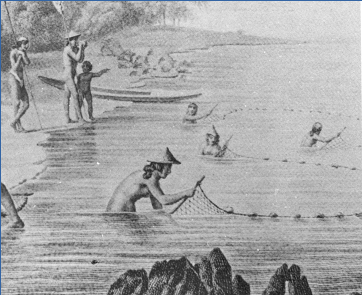
After the reduction, we are told that village residents would spend at least one day a week, sometimes two or three, working on these land parcels.[xlviii] After all, the island lifestyle in the early 1700s was much the same as it had been formerly. Local people supported themselves as they always had, by subsistence farming and fishing. They spent much of their time on their ancestral estates, or in the case of those resettled from other islands, on the lands the Spanish had given them to farm, growing rice and cultivating taro and the other usual root crops.[xlix]
Yet, there were some changes in what they produced. Many villagers also raised animals recently introduced by the Spanish, chickens, pigs and cows, for their own consumption or for sale to the passing ships in exchange for trade goods: iron tools, knives, cloth and tobacco.[l] As early as 1698, one missionary reported that the products taken on by one of the Spanish ships at Guam included pigs, calves, watermelons, bananas, pineapples, sweet potatoes and melons as good as those in Spain.[li] The local people living in the new villages could cultivate these new crops with the confidence that they could retain the fruit of their labor, for by royal decree they were exempt from taxes for twenty years following their conversion.[lii]
In addition to their food crops, the villagers also planted tobacco. As one of the missionaries explained: People have become so addicted to tobacco that men and women, boys and girls, walk around with pipes. In the past their only substitute for money was iron,… but now they value tobacco above all else, and tobacco has become the common currency with which one can buy and obtain anything. For a hen we pay two tobacco leaves, and for one leaf of tobacco a man will work all day.[liii]
The profits of this trade were intended to accrue to the people who had raised the crops and livestock, but this was not always the case. During the early years following the reduccion, this surplus was coopted by the governor for his own gain. According to one Spanish resident, the villagers were required to plant and tend fields of rice, corn, melons and root crops on royal land, as well as raise pigs and poultry, all of which was supposedly for the support of the garrison. In actual fact, however, the food raised by the local people was either used at the governor’s own table or sold… with the profits going to the governor.[liv] Work demands were imposed on women as well: They collected copra to feed the pigs, made salt and oil, and plaited sleeping mats and canoe sails of pandanus to be sold in the Philippines.[lv]
A royal decree had made the people of the Marianas exempt from the royal tribute normally levied on local populations under Spanish control to spare them hardship. But a compulsory labor requirement of 40 days a year was imposed on the local people, with the fruits of this being used to provide for unforeseen needs that might arise on the island.[lvi] This labor tax (or apluy) was utilized, and even expanded, by a string of avaricious governors for their own personal benefit. This abuse was finally corrected in 1726 when Governor Arguelles took office, lessened the number of work days and lightened the work load imposed by his predecessors.[lvii] It is important to understand, however, that the poverty that the village people had to endure during those years was due to the heavy labor demands made by the governors, not because the villagers were denied access to their own productive land.
Over the course of the next century and a half, we might note, several attempts were made to initiate wide-scale commercial agriculture, but the proposed changes were never successful. Farming continued as the family affair it had always been in the Marianas.[lviii]
Recreation
Comedians by nature, lovers of fun and fiesta, is how one of the early missionaries described the Chamoru people. We know little about traditional festivals in the village and what they celebrated. Such accounts as we have, however, describe the type of activities in which villagers engaged during these festivals. The same priest continues: The men get together to dance, to play with lances, to run, leap, wrestle and test their strength in various ways. And amid these entertainments they retell with great laughter their stories or fables, and generously share food…. The women have their own fiestas…[lix]
This suggests that the Chamoru people would have found a way to exhibit their fun-loving spirit through whatever outlets the new villages offered. We may assume that the church fiestas that soon became so central to village life provided one opportunity to display this characteristic. As the years passed and villages grew to become towns or cities, we find the same trait displayed at family barbeques, church fiestas and public gatherings today.
Music and dance, we may assume, were important components of these early celebrations. One of the earliest accounts describes women’s entertainment. Twelve or thirteen women get together in a circle, without moving from one spot, and sing in verse their stories and ancient lore with measured time and three-part harmony… Movements of the hands accompany the voices, so that with the right they go on forming half moons, and in the left they have small boxes full of little shells that serve as castanets.[lx]
The standing dances with emphasis on hand movement may not have found a place in church activities, but the women’s choirs provided ample outlet for their musical harmony in the new village.
Competition was another strong feature of traditional island life, as we know from various accounts. In its most extreme form, of course, competition was behind the inter-village warfare that was waged from time to time. The battles between villages, as in other parts of the Pacific, were often as much contests of display as of armed prowess. But even when battles were still being fought between villages, other less lethal forms of competition were common, as we know from early sources. Young men engaged in wrestling and also in spear-dodging contests. There were still other competitions in the recitation of traditional tales and legends, not to mention the teasing contests for which the islands were renowned in the eyes of early visitors.[lxi]
The tradition of competitive teasing would find other outlets and forms as the decades passed, and the trait has survived to the present, as the impromptu singing at family barbeques attests. So also would the tests of physical skills, offering testimony to the important place that sports have always held on the island.
The Place of the Church in the Village
The church, which would play an ever larger social role through the years, established new dress standards on the island. Islanders’ dress was one of the most visible changes in this new era. Women had shed the leaf or turtle shell covering over their groin in favor of cloth skirts, which had quickly become fashionable. Men, who had once gone entirely naked, were now wearing loincloths or trousers. One priest writes that even in Rota tunics have been woven from an inner fiber of trees by which the men and women cover themselves more decently.[lxii] In 1691, one of the missionaries could report that generally speaking, both men and women try to dress decently, even when they work in the fields[lxiii] At the forefront of this change in fashion were the young students at the mission schools, boys decked out in white linen trousers and blue vests while girls sported blouses and skirts of fine white cloth. [lxiv]
The nudity of the pre-contact islanders might be attributed to the lack of materials and technology to produce comfortable clothing rather than a dislike of dress. Wearing plaited leafy material was far less appealing than being clad in a loincloth or skirt made of finely woven material. The Marianas, it appears, never had the looms for weaving banana or hibiscus fiber into cloth that were common throughout the Caroline Islands. Certainly, the early inhabitants of the Marianas were fond of bodily adornment, as the early missionaries could attest. The women have their own fiestas, in which they adorn themselves with pendants on their foreheads, sometimes with flowers like jasmine, or beads of glass or tortoise shells… They also make belts of them with which they gird themselves, adding pendants made of small coconuts, beautifully arranged over a skirt of hanging roots of trees… which looks more like a cage than a dress.[lxv] Weaving, introduced by the Spanish in the 1670s, was an instant success, and it was not long before clothes became fashionable.
Dress may have changed, but other things remained largely as they were. Gender divisions were observed as they always had been in the occupational and social life of the village. Women continued to do light gardening, shoreline fishing, and most of the preparation of the food and cooking, while men did the deep sea fishing, gathered wild fruit and did the heavy work in the fields. Women assumed the new chore of washing the family clothing, probably in clusters as they chatted (as would have been true in other islands through the ages). House-repairs were divided between men and women, with the men doing the construction work and women the thatching.
The church quickly assumed a central role in the social life of the village, as the mission letters triumphantly reported. Church bells rang at different times throughout the day to summon people for prayer and to announce village events. The newly converted islanders learned their Latin mass responses, chanted their devotions, and prayed the rosary together daily. Those same mission letters enthusiastically highlight the dramatic changes in the life of the Indios that marked their progress toward Christianity and what they regarded as civilization. The public houses are now demolished; tunics woven from the inner fiber of trees are now used; legitimate marriages have been made; children are baptized whom the parents bring in from far and near; the dead receive Christian burial; and the sick are brought to the church for the sacraments on the shoulders of relatives.[lxvi] The island people, in the eyes of the missionaries, were rapidly abandoning their heathen ways to become a new people.
But were islanders, now living in the altered village landscape with the church occupying a central position, truly jettisoning all their traditional customs and values? Or were they, like so many other newly baptized peoples elsewhere, learning to assimilate some of the features of their traditional lifestyle into this new landscape?
For one thing, church life largely honored the same gender divisions that were found in traditional life. Men were seated on one side of the church, and women on the other. The religious organizations were also largely divided by gender, with men’s and women’s associations providing social outlets for each as they did in Europe and continued to do in the islands almost up to the present. The Congregation of the Holy Name of Mary was one of the first church organizations for women, but others would soon follow.[lxvii]
Women in the new church continued to play the prominent role that they had in their pre-contact village community. Although the main authority figure in the church was the foreign pastor, select women soon became recognized for their role as techa. Always more than simply catechism teachers, these reliable women became the heart of the parish and served as signs of stability even as they helped make key decisions in the life of the church. In other words, women acquired a role in the new church that was similar to the role they would have had in the traditional village. They might not have announced the decisions, but they certainly had a large hand in making them.
Young people may have no longer sung aloud their creation myths, but boys and girls would sing the litanies in harmony as they romped though the hills or worked in the fields.[lxviii] When children came out to welcome a visiting mission party into their village, they would sing prayers in Chamoru and Spanish as they processed to the church.[lxix] But young people were not alone in embracing the hymns and chants of the new faith. Women, too, seemed fond of the new church devotions set to music. In Hagatña in 1680, one Spaniard marveled, women would meet in the church to sing their prayers every evening, with some of the prayers beginning at 7 o’clock, some at 8, and some at 9. Music could be heard even at 10 in the evening.[lxx] In the church that had just become central to village life, there was a rich variety of outlets through which people could express their musical talent: parish choirs, chanted prayers, sung devotions and so many more.
The islanders, under the frown of their parish priest, gave up the recitation of their own historic tales, which had been a competitive pastime for them in pre-Christian days. But they were soon offered a substitute: the church catechism. Mastery of the faith, as summarized in his booklet, was mandatory for converts. The older men and women know that it is a strict rule that no one can receive confession and communion… if they do not know their catechism.[lxxi] The Jesuit then goes on to tell of the 70-year-old man who, when informed of this condition, went home and studied for a month until he could recite it without hesitation. The task might have been slightly less daunting because he had probably memorized numerous legends as a boy.
Right from the outset the converts to Christianity displayed a strong affection for Mother Mary, with many hugging the statue in church and praying the rosary while walking or at home. [lxxii] This devotion, so readily elevated to a central place in people’s understanding of their faith, may reflect the importance of women’s nurturing role in the island family and in the society at large.
Overall, we might conclude that the church was a significant addition to the old village life. It became the central institution on the island just as it served as the focal point of social life in the post-reduction village. Even so, the flavor of much of the traditional society lived on, even if now embedded in an organization that was expressly religious. Moreover, the church had a unifying effect on the people. It brought villagers together more strongly than ever before, whatever their lineage and clan. Beyond this, the church became an instrument of unification of the people of Guam, for it offered a structure broad enough to embrace all the villages of the island and beyond.
Village Authority: Who Held the Power?
Even after the reduction, matrilineality and matrilocality almost certainly continued as a general pattern in the villages. A comparison of census data from 1728 and 1758 confirms that matrilocality survived through at least the mid-1700s, with men normally leaving their village to marry, perhaps because of the prohibition of marriage to a woman of his own clan.[lxxiii] The census lists also show that islanders had not yet adopted the custom of taking a family name, especially one that was handed down from the father to children. Sometime during the 19th Century the Chamoru people would adopt this custom, but in the aftermath of the resettlement there was still no hint of a shift from the matrilineal to the patrilineal. The census lists make it clear that an individual had two names, an island name and a Christian name.[lxxiv]
In the early attempt to concentrate the population into villages in 1680, Governor Saravia intended that local people would provide the leadership in these villages. This, then, would mean retaining the authority system built on the local matrilineal village system. Besides preserving the village leadership system, Saravia wished to recognize some of the outstanding Chamoru leaders by bestowing on them island-wide titles. Thus, he named Antonio Ayihi, one of the strongest supporters of the missionaries, Maestre de Campo and Lieutenant Governor of the island, presenting him with the silver insignia of his office.[lxxv] Alonso Soon, who assisted in the campaign against Talofofo and Picpuc was named Principal y Sargento Mayor of Agat and Umatac about the same time.[lxxvi] Along with their titles, the leaders received such Spanish symbols of authority as the baton or scepter.
Even as Saravia took the first steps in promoting island-wide leadership, he also formally recognized the traditional Chamoru leadership in the villages. Accordingly, he bestowed on each village chief the Spanish military title of maestre-de-campo.[lxxvii] It is important to note that the conferral of this title was not a means of replacing the traditional chief, but a gesture to confirm his authority. The problem is that when other smaller villages were consolidated into the larger village to create a pueblo, there might have been two or three former chiefs contending for the chieftainship of the larger village. Ideally, the authority system could have been expanded so as to give recognition to the chiefs of the other villages that were consolidated in the pueblo. As it was, the chieftainship seems to have gone to the traditional head of the main pueblo, with little recognition given to the heads of the other smaller villages that had been absorbed into the village.[lxxviii] This might have caused push-back from the latter and their followers. In any event, the chief of the main village was expected to exercise authority over those from the neighboring villages that had been consolidated into the former. The authority of the village chief was limited even in traditional days. But to exercise that authority in the new system, when there may have been other contenders for leadership, would have been even more difficult.
As if this were not bad enough, the village chief (by then known as alcalde) would have been expected to see that his people carried out the excessive labor demands being imposed upon the villagers by the string of greedy governors who held office during the early years of the reduction. Under Governor Damian Esplana (1683-1694) and two of his successors, Governor Juan Antonio Pimentel (1709-1720) and Governor Luis Antonio Sanchez de Tagle (1720-1725), the village leader was supposed to ensure that the people provided the extensive labor in the fields that would ultimately enrich the governor at the expense of those who owned and worked the land.
This might explain the reluctance of the chiefs to take on the title, instead suggesting that a Filipino or other outsider take the job. One priest attributed this reluctance to the failure of local chiefs to command the respect of their own people due to the haughtiness and arrogance of the latter.[lxxix] But there was assuredly much more to the matter than this. In any event, as the burden placed on the village chiefs became heavier, they reportedly came to the Governor of the Marianas to ask him to appoint a Spaniard as head of the partido.[lxxx]
The reluctance of village chiefs to exercise their leadership left the door open for some of the self-serving governors over the next several years to appoint and control the village mayor, or, as he was then formally called, the alcalde mayor. If the governor did not appoint the alcalde outright, he might exercise his authority to name a mayordomo for the village to act in his name. These officials would have better been called overseers, one source caustically points out.[lxxxi] The governors, notably Esplana, Pimentel and Tagle, used these village officials to enforce excessive labor demands from the people, the fruit of which would allow him to meet local requirements while saving the yearly Spanish subsidy for personal investment in the galleon trade. The excessive work demands were an additional burden upon a people already racked by disease and whose number was decreasing with each year.
By 1725 the worst was over; the last of the greedy governors had left office. Governor Arguelles attempted to reform the system by eliminating the office of alcalde mayor and returning authority back to the local village chiefs. But the local authorities proved unequal to mounting relief efforts in the wake of a severe typhoon, presumably because of the old problem: the difficulty that the heads of the matrilineages had in exercising authority after the consolidation of villages when there would have been other contenders for his position.[lxxxii] Spanish authorities at that time, as they had 45 years earlier, recommended that Chamorus be made leaders of the villages and supervise the Crown lands in the district (partido) but on both occasions this proved unsuccessful.[lxxxiii] In all likelihood, it was too late to expect the rightful chiefs to adapt to the responsibility of village leadership as it had been redefined over the years.
By the early 19th Century, even if the leadership of the village was no longer passed on to the matrilineal village chief, the position (now renamed gobernadorcillo) was still held by a Chamoru.[lxxxiv] The traditional village authority system, which had been preserved by Saravia, was tweaked by other governors during the early years of the reduction, as we have seen. The governor’s own appointee had been added to ensure that the village meet its work quota and satisfy the governor’s demands for resources. Meanwhile, the Jesuit pastors had created the office of fiscal to help them oversee the religious life of the village. In addition, a number of military titles (eg, maestres de campo, sargentos, capitanes) were bestowed on important individuals in the village. By 1787, the village authority system was standardized in accord with that in the Philippines. Military titles were abolished, and the indigenous head of the village was to be called gobernadorcillo. Village leadership had been transformed over the decades, as had much of the matrilineal system that undergirded it, but the village head (whatever he might be called) remained an islander.[lxxxv]
The Special Case of Hagatña
Hagatña, although the site of the original Spanish colony, had a population not much larger than any of the other villages in 1690. It was only after the end of the hostilities and the resettlement that the population rapidly increased, peaking at 900 by 1710, although the number dropped to 600 or 700 for the remainder of the century. Dignified in 1687 with the status of ciudad, or town, Hagatña took on some of the features of a Spanish provincial capital.[lxxxvi] From the outset the village had housed the Jesuit priests and their mission staff, a small boys school, and a church that was later rebuilt in stone and enlarged as the Christian congregation grew. During the hostilities, it had acquired a military barracks for the garrison, a government storehouse, and walls hastily erected to fortify the town when it was under siege. As Hagatña was recognized as the capital, a modest building to serve as the governor’s residence and a plaza were added.
Even by 1680 Hagatña had taken on the aura of a colonial town. One of the priests described it in the following words:
This town has as many as 200 houses in which live soldiers and some of the friendly Chamorros. The whole is enclosed by a stockade with two gates, one on the sea side and the other on the mountain side. … Our Jesuit house is competently arranged, with the outer walls made of stone and mortar and the inner walls of wood. The Governor has a very good house that serves as a fort, and its royal warehouses in which are kept the relief supplies that come from New Spain and its storage vaults and granaries to keep local food supplies: rice, corn and fish (supplies found locally in abundance).[lxxxvii]
The newly rebuilt church in Hagatña reflected the town’s new status. It was large enough to hold 1,000 people; but its expanded size was necessary, we are told, because people were coming from two leagues around for Sunday mass.[lxxxviii]
Yet, during the troubled times of the past decade, Hagatña had also taken on many of the features of a fortress. The population of the town in 1680 included about 130 soldiers from New as well as Old Spain and from the Philippines.[lxxxix] The garrison was large enough by that time to warrant a stone church of its own as well as an infirmary solely for the troops. Other imposing features had been added. There is a sufficient provision of arms, four artillery pieces which they brought into the garrison this year. A fort has been built, made of wood. The enclosure, which until now was a wooden stockade, is being changed to stone.[xc]
Even before the coming of the Spanish, Hagatña had probably been one of the most prestigious villages on the island, as is suggested by its favorable location on the coast near a popular port. Its importance was enhanced when it began to host the Spanish missionaries with access to foreign goods they offered the island population. Several of Hagatña’s leaders were honored with titles back in 1680, and a few achieved island-wide recognition for defending the missionaries and promoting their work throughout Guam.
As Hagatña grew, it took on much more of a Spanish hue that any of the other villages on the island. The town’s foreign-born population, which may have numbered 200 in 1690, doubled to 400 by 1710.[xci] These would have included survivors from the original mission party as well as active troops along with former members of the garrison who had taken Chamoru wives. The Spanish nationals (mostly Mexican creoles and Filipinos) became the inhabitants of the town proper, while the Chamoru people from the area would have lived in the adjacent barrios, those nearby villages (including Sinajana, Anigua and perhaps Tamuning) that had been subsumed by Hagatña during the reduction. The local people may have been situated close enough to the town to attend church there, but they had otherwise surrendered authority to the new elite. All in all, Chamoru leadership in Hagatña at the time of the reduction would have been untenable because of the large number of foreign residents.
Meanwhile, Hagatña was being rebuilt as the island settled into peaceful village life. Governor Arguelles de Valdez, who took office in 1707, began construction of yet another, more ornate church built from blocks of coral. The church, with its three naves, was designed to be worthy of a Spanish provincial capital.[xcii] long with the church was a rectory, a cuartel (barracks for the troops), and a palacio, or residence for the governor.[xciii] There was also a boys school and a girls school. The new face of Hagatña, with its central area increasingly built in stone, reflected the growing distance between the town that had become the island capital and the other villages on the island.
Religious Practice and Belief
Religious mythology might have been elaborately developed in the Marianas before the coming of Christianity, but the creator-gods or sky-gods had a minor role in the ordinary religious practices of the people. The Spanish missionaries observed that although people memorized and sang the creation story involving Puntan and his sister, there is no one who renders Puntan or his sister any worship or visible ceremony, invocation, or petition.[xciv] In this the people of the Marianas were no different from any other island group in Micronesia. Stories might abound on the sky gods like Puntan, but the religious life of the island people centered on spirits, especially ancestral spirits and nature spirits.[xcv]
Venerating Ancestral Spirits
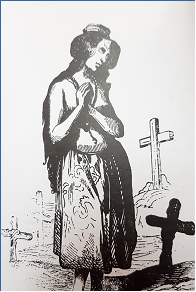
The veneration of ancestral spirits seems to have been as important in the Marianas as it was in other parts of the region. The skulls of deceased family members, mentioned so often in the old Spanish accounts, served as shrines to their spirits.[xcvi] The body of the deceased person might be honored by the family and other villagers for some days before the bones were removed, cleaned and deposited in a cave for future veneration. The spirits of prominent ancestors were consulted by the family, through spirit mediums known as makana, in time of need.
In the new religion introduced by the Spanish, the veneration of the dead was continued, although in a different form. Instead of removing the bones, cleaning them and depositing them in a cave for veneration, the Christian villagers held formal processions from the home, to the church for solemn ceremonies, and then to the cemetery for burial in a family plot. According to one account, The priest and his servers would accompany the bier, draped in black cloth stitched with crosses, from the house of the deceased to the church, and after the funeral service… to the small cemetery to the church for burial.[xcvii]
The custom of gathering nightly to say the rosary for anyone who had died in the village began as early as 1698, we learn from the early Spanish sources.[xcviii] The celebrated practice of holding the rosary for nine days, which has continued up to the present, is not unlike the traditional Chamoru wake. The length of this traditional wake might extend to seven or eight days, depending on the status of the deceased, and was attended by most of the villagers. The mourners would spend these days singing sad songs and having funeral meals around the mound they raise over the grave or near it, decorated with flowers, palms, shells and other objects which they value.[xcix]
In pre-Christian times, a spirit venerated by a single family might sometimes develop enough of a following to become the patron of an entire village. Ancestral spirits, after all, were consulted from time to time since they were formerly regarded as protectors. In Christianity, believers regularly prayed for deceased family members and friends, but they also prayed to the saints as if to protector spirits.
This veneration of the heavenly spirits for protection reached its height in the fiestas in honor of the patron saint of the village. According to one account, the feast days of the patron saints of the churches drew crowds from all parts of the island. After the mass there were processions, led by standard-bearers, with the congregation singing hymns, sometimes accompanied by musical instruments as the faithful wound through the village passing under decorated arches and waving palm fronds all the while.[c] The parish fiesta, with all that it involved, soon became the village event of the year. This enduring feature of Spanish Catholicism fit as easily into the Chamoru belief system as it did in the Philippines and Mexico.
The patron saint of the village was by no means the only saint venerated by the villagers in this new era. The list of Christian saints passed on to the new converts was long and ancient. They were remembered during the daily mass each morning as the feast day of each appeared on the church calendar. Novenas to some of these saints were introduced as additional devotions in the life of the church, another popular practice that has continued to the present. The litanies, prayers that honored many of these saints, were soon translated into the local language. As early as 1690, as we have seen, boys and girls would sing the litanies in harmony in an exercise that was as much recreational as it was devotional. But we need not be surprised at this. The island people had been accustomed to singing bits of their own traditional lore, as we have seen. Now they were simply singing their prayers of petition as they implored this new host of heavenly spirits for the protection they had formerly sought from their family ancestral spirits.
But what of their own ancestral spirits? Their skulls were no longer kept to serve as shrines, as they had been in the past, and the spirits themselves were no longer consulted through mediums for their advice on family or village matters. Yet, they were by no means forgotten. Although the deceased were now interred in church cemeteries, their families continued to visit their grave sites, often bringing flowers to celebrate their lives and kneeling in prayer to remember them. It’s not too much to believe that villagers would have retained something in their homes as a memorial of their departed family members, just as today photos are displayed to commemorate loved ones who have passed away.
The grand remembrance of family spirits, however, occurs on All Souls Day (November 2) when the spirits of all the dead are remembered in a church festival that still today holds a special place in the life of the community. The feast of All Saints on the preceding day is eclipsed by the observance of All Souls Day. Families gather at the cemetery to pay respect to their departed family members, sometimes even spending the evening before at the cemetery. Graves are cleaned and decorated, the dead are honored, and mass is celebrated in the graveyard for all the deceased. Those ancestral spirits that were venerated in the past are very much venerated today, and many of the forms, although altered, are still recognizable today. Perhaps the most significant change, however, has been the collectivization in the remembrance of the dead. The entire village now gathers to commemorate the spirits of its deceased, especially on the one day of the year set aside for this purpose.
Controlling Harmful Spirits
Besides the ancestral spirits venerated by the islanders, there were also the harmful spirits (taotao mona) that had to be dealt with. This class of spirits were usually bound to a certain local feature, a rock outcropping, a tree, a particular shoal, and were believed to be sensitive to intrusion. They had to be placated and guarded against for fear that they might do serious injury to the interloper. Hence, the concern to protect persons from these dangerous spirits, not to mention enemies who might employ magical powers against them, was a major component in the religious practices of pre-Christian islanders.
Christianity offered a wealth of symbolic means for affording the protection islanders sought. When an island leader found that rats were attacking the crops in their field, they pleaded for help from a priest. The priest instructed him to raise a cross in the middle of the field and then went out to bless the field with holy water. The missionary reports at this time (1690) are filled with stories of how people sought protection from malevolent spirits. Erecting a cross, drinking holy water against disease, and receiving priestly blessings were all used as means of protection under the new religion.[ci] The sick began drinking holy water… to ward off death and aid recovery. A cross could be found in just about every house since it was revered as a means of protection against diabolical powers and other evils.[cii]
The same spiritual forces were at work for the new Christians on Saipan. As plans were being made to gather the lumber needed to build the new church there, some of the men picked for this task began to show fear of the spirits that were believed to dwell in the woods. When one of them, the island catechist, ventured into the woods anyway, he fell sick and became delirious with fever. This only confirmed the worst fears of the others. But when the relic of a saint was applied to his body, the sick man was quickly healed.[ciii] This only strengthened the growing popular belief that the new religion offered the resources needed to protect against all harmful spirits, whatever their nature.
Conclusion
Let’s recall the question addressed in this essay. What are the cultural links between those naked islanders who boarded the ship to greet those Spanish missionaries at their first arrival and the clothed and converted inhabitants of those few remaining villages on Guam in 1700 under the Catholic faith and the Spanish flag? Is there evidence for genuine cultural survival after three decades of heavy influence from abroad?
From a comparison of the pre-contact village with the typical post-resettlement village, we may draw these general conclusions.
- The village after the reduction was not so much larger than it had been before, even if there were fewer villages on the island by then. Moreover, the population of these villages, except for Hagatña, remained almost entirely local.
- Houses and buildings in the village, with the exception of the clubhouses, which had been eliminated by that time, were retained and constructed in largely the same way as formerly, although this would change over time.
- The villages retained their matrilineal character, although the consolidation of nearby settlements made the governance of the few villages more problematic. In general, women retained their traditional influence.
- Villagers depended on the produce of the land and the sea as they always had. Whatsmore, the lanchu continued to be utilized after the reduction much as land parcels outside the village probably had been in earlier times.
- Clothing was perceived by islanders not so much as a constraint as an opportunity for the sort of display that islanders had occasionally devised for themselves in early society.
Thus, it would appear that the reduction into villages in the early 1700s did not mean a sudden break with all earlier practices. Traditional land use patterns, village authority, matrilineality, and the major forms of village life did not suddenly cease. There was a carry-over into the village life at this time, whatever changes might have occurred during the following century or two.
When the church became the center of village life, it undeniably introduced major new features into the life of islanders. But the church provided more than just religious services. It also functioned as an institution that allowed islanders to display many of the cultural features so important in their earlier social life. In doing so, the church honored the gender division that was a key component in island culture.
Church practices, even in the earliest years, showed unmistakable signs of the assimilation of features of early Chamoru culture. The church fiesta, for instance, provided an opportunity for expressing village unity, just as the old village gatherings had. In addition, the fiesta provided a new and enduring social link with the other villages invited to join the celebration. At the same time, it offered an outlet for the fun-loving nature of the islanders, so often recognized by early visitors, even as they shared food with one another, a binding element in island life.
Other examples of cultural assimilation presented in this essay can be summarized as follows.
- Religious devotions, from the choirs at mass to the litanies sung in the fields, offered an opportunity for the musical expression of the people ,while the recitation of the catechism substituted for the legends that had been memorized in earlier times.
- Veneration of the ancestral skulls that was once so common in the Marianas might have continued in new forms under Catholicism. Reverence for the dead was displayed in church burial rituals, including rosaries and novenas, and the great importance of All Souls Day in the islands. The old custom of gathering for several days after the death of a villager was incorporated into the church practice of offering the rosary nightly during the wake.
- The protective powers of the ancestral spirits might have been incorporated into the veneration of saints for help against all sorts of dangers. Moreover, the church provided practices that offered protection against malevolent spirits, for instance, blessing with holy water, application of relics, and the use of the cross as a talisman. Indeed, belief in nature spirits may well have continued after conversion, as it often did elsewhere in the Pacific.
These values and important features of traditional Chamoru society were not altogether discarded, despite the institutional changes that took place as the church was established on the island. Many of these continued in other forms even as the island society was being transformed.
The reduction of the islanders into villages, following the tumultuous 30 years of early Spanish missionary contact, certainly produced significant changes in the social environment. This is beyond contention. But many (early authors and even apologists today) regard this as radical discontinuity with the past, the taming of the free-spirited islanders into a submissive people settled in Spanish-governed villages. As one author concluded, the tiny group of Jesuits and their Filipino and Mexican assistants… changed the lifestyle of a fiercely independent island people, a lifestyle characterized by long established settlement patterns that depended on ready access to the sea for food and mobility.[civ]
In this view, the Chamoru people were subjugated by force and compelled to deny their cultural past even as they were required to abide by the new rules of the resettled villages. Thus, in learning to make the sign of the cross and salute the Spanish flag, they were renouncing their own cultural identity. Indeed, many of the missionaries of this period, with their emphasis on the success of religious conversion and the shedding of old ways, contributed to the sense of cultural distance between the past and present.
But this is to ignore the fact that these free-spirited people were subject to cultural rules and bound by social norms even before the arrival of the Spanish. A few of these norms are hinted at in the early Spanish documents from this period, but many others may be inferred from our understanding of other matrilineal island groups in the region. As we take account of these social rules, we find that the freedom of the pre-contact islanders might be exaggerated. Moreover, when we examine more closely the features of those villages into which the islanders were resettled, we may conclude that their new village life offered much more freedom of cultural expression than we might have once believed.
Even allowing for forced resettlement in some cases, especially of people from the northern islands, there is evidence that not all the changes that occurred during this time were imposed on the island people. Some of the new features of life, explicitly religious or not, were welcomed if not actually chosen by them. The adoption of new crops and farm animals, weaving of cloth, and selection of village leaders are just a few examples, as we have seen.
Culture is, and always been, a living force that may transform even new institutions as it adapts these to the social environment. We have reviewed ways in which the church and its devotional life in the islands may have assimilated strong cultural features of Chamoru life, as in respect paid to the dead, honor given to ancestral spirits, and forces used to combat evil spirits. Even as cultural forms change over time, the flavor of social life and cultural identity persist, as anyone who has lived through the changes of the past few decades can readily testify.
Francis X. Hezel, S
References
Abella, Domingo, 1962. Vignettes of Philippines-Marianas Colonial History. Manila, International Association of Historians of Asia, March.
Atienza, David, 2014. Priests, Mayors and Indigenous Offices: Indigence Agency and Adaptive Resistance in the Mariana Islands, Pacific Asia Inquiry, Vol 5(1): 31-48.
Atienza, David, In Press. Historical Complexity and Indigenous Continuity of the Indigenous Chamoru during the 18th Century.
Coomans, Peter, 1997. History of the Mission in the Mariana Islands: 1667-1673. Translated and edited by Rodrigue Lévesque. Occasional Historical Papers Series No 4. Saipan: Historic Preservation Office, CNMI.
Dobbin, Jay, 2011. Summoning the Powers Beyond: Traditional Religions in Micronesia. Honolulu: University of Hawaii Press.
Driver, Marjorie, 1987. Cross, Sword, and Silver: The Nascent Spanish Colony in the Mariana Islands. MARC Working Papers No. 48. Micronesian Area Research Center, University of Guam.
Driver, Marjorie, 1989. The Account of Fray Juan Pobre’s Residence in the Marianas, 1602. Guam: Micronesian Area Research Center, University of Guam.
Driver, Marjorie & Francis Hezel, 2004. El Palacio: The Spanish Palace in Agaña 1668-1898. Guam: Micronesian Area Research Center, University of Guam.
Freycinet, Louis de, 1839. Voyage autour de monde… pendant les annees 1817, 1818, 1819, et 1820. Paris: Pillet Aine. Part 1: History; Vol 3.
Garcia, Francisco, 2004. The Life and Martyrdom of the Venerable Father Diego Luis de San Vitores. Edited by James A. McDonough, S.J. Mangilao: Micronesian Area Research Center, University of Guam.
Hezel, Francis X., 2000. From Conquest to Colonization: Spain in the Mariana Islands, 1690 to 1740. Occasional Historic Papers Series, No. 2. Historic Preservation Office, Saipan, CNMI.
Hezel, Francis X., 2001. The New Shape of Old Island Cultures. Honolulu, University of Hawaii Press.
Hezel, Francis X., 2015. When Cultures Clash: Revisiting the >Spanish-Chamorro Wars. Northern Marianas Humanities Council, Saipan, CNMI.
Ibañez y Garcia, Luis, 1886. Historia de las Islas Marianas. Granada, Sabatie.
Lawcock, Larry, 1982. Extinguish the Government, Pacific Daily News: Islander Supplement. Guam. February 21.
Lévesque, Rodrigue, 1992-2002. History of Micronesia: A Collection of Source Documents. 20 vols. Québec: Lévesque Publications.
Madrid, Carlos, 2014. Ritidian and Sonsong Across the Rota Channel, in Mike T. Carson, ed, Guam’s Hidden Gem: Archaeological and Historical Studies at Ritidian (Oxford, Archaeopress), 44-52.
Repetti, W. C., 1940a. An Early Church Census on Guam, Guam Recorder, March, 505-506.
Repetti, W. C., 1940b. Seventeenth Century Letter from the Island of Rota, Guam Recorder, July, 319-320.
Repetti, W. C., 1941. Letter of Fr. Bouwens to Fr. Noyelle, 1684, Guam Recorder, June, 95-96
Repetti, W. C., 1946. The Beginnings of Catholicity in the Marianas Islands, Catholic Historical Review, Vol 31: 431-437.
Russell, Scott, 1998. Tiempo I Manmafo’na: Ancient Chamorro Culture and History of the Northern Mariana Islands. Micronesian Archaeological Survey Report No. 32. Saipan: Division of Historic Preservation.
Viana, Augusto de, 2004. Filipino Natives in Seventeenth Century Marianas: Their Role in the Establishment of the Spanish Mission in the Islands. Micronesian Journal of the Humanities and Social Sciences, Vol 3(1-2): 19-26.
[i]. Hezel 2015: 79-81
[ii]. Hezel 2000: 31
[iii]. Census of 1728, Archivo General de Indias (AGI), Ultramar, Leg 561, ff 127-186.
[iv]. Hezel 2000: 25; the data cited is from ARSJ Filipinas 14.
[v]. Viana 2004
[vi]. Atienza 2014: 33; see also Hezel 2015: 9.
[vii].Fr.Solarzano to Fr. Francisco Garcia, 20 May 1681, in Levesque 7: 440.
[viii]. The third and final siege of Hagatña, in 1684, was far more serious than the previous ones. Casualties were far higher, and the intention of this final siege seems to have been to eliminate the mission party once and for all. See Hezel 2015: 61-66; and for a more detailed first-hand account of this final siege see Fr. Morales’ annual report for 1684-5 in Abella 1962.
[ix]. On Chochogo, for instance, see the letter of Quiroga, to Duchess of Aveiro, 10 May 1680, in Levesque 7: 213. For troubles in Nisichan, see Garcia 2004: 192, 211.
[x]. Sidia and Ati are mentioned in Garcia 2004: 431. For Talofofo and Pigpug see Garcia 2004: 482. Tarragui and Hanum are referred to in Garcia 2004: 484, 490; in Fr. Besco’s annual report for 1679-80, Levesque 7: 222; and in Quiroga’s letter to Duchess of Aveiro, 10 May 1680, in Levesque 7: 211.
[xi]. Cited in Garcia 2004: 173
[xii]. Garcia 2004: 173
[xiii]. Letter of Fr. Cardenoso, 2 May 1693, ARSJ, Filipinas 14, ff 83-84; cited in Hezel 2000: 21.
[xiv]. Coomans 1997: 7
[xv]. Coomans 1997: 16
[xvi]. In all likelihood, the early pre-latte settlers were displaced from the choice settlement sites on the coast by later waves of migrants, as happened so widely throughout the Pacific. But in the absence of real evidence, we can only assume that this was the case.
[xvii]. Garcia 2004: 172
[xviii]. Indications of matrilineality are scattered throughout the missionary documents; see Garcia 2004. They are even to be found in the memoir of a friar stranded on the island for several months long before the arrival of San Vitores and his companions: see Driver 1989.
[xix]. Note, however, that even if the family is traced principally through mother’s side, patrilineal ties are observed even if they are of less importance.
[xx]. Garcia 2004: 169
[xxi]. Fr. Xaramillo, annual report 1679-80, Levesque 7: 319.
[xxii]. Garcia 2004: 172
[xxiii]. The limits of the authority of the village chief are underscored in the last part of the quote: Neither the islands taken altogether nor the individual villages have a head who governs the others. (Garcia 2004: 172).
[xxiv]. Coomans 1997: 7
[xxv]. Coomans 1997: 7
[xxvi]. Quiroga to Duchess of Aveiro, 10 May 1680, Levesque 7: 211
[xxvii]. On Ritidan, see Fr. Morales, annual report for 1684-1685, Abello 1962: 14, 17. On Tarragui, see the letter of Quiroga, to Duchess of Aveiro, 10 May 1680, Levesque 7: 213; and Garcia 2004: 489.
[xxviii]. Garcia 2004: 503; Fr. Solorzano To Fr. General Oliva, 25 May 1682, Levesque 7: 545.
[xxix]. Garcia 2004: 491-2
[xxx]. Garcia 2004: 458
[xxxi]. Garcia 2004: 457
[xxxii]. Both villages were added to the list of pueblos by 1696, as Table 2 indicates.
[xxxiii]. Cited in Atienza, 2014: 32
[xxxiv]. Fr Solorzano, annual report 1681-1682, Levesque 7: 557
[xxxv]. Fr Coomans, report for 1680-1682, Levesque 7: 566
[xxxvi]. Freycinet 1839: 331-3
[xxxvii]. Hezel 2000: 18, fn 30
[xxxviii]. Freycinet 1839: 354
[xxxix]. Hezel 2000: 15, citing figures from Freycinet 1839: 331
[xl]. Census of 1728, AGI, Ultramar, Leg 561, ff 127-186.
[xli]. Fr Coomans, report for 1681-1682, in Repetti 1940: 319-20.
[xlii]. Fr. Xaramillo, annual report 1679-1680, Levesque 7: 307.
[xliii]. Fr. Xaramillo to the King, 29 June 1684, Levesque 8: 143.
[xliv]. The cook house, even if the style varied from one culture to another, was a standard feature throughout Micronesia.
[xlv]. Coomans 1997: 11
[xlvi]. Coomans 1997: 12
[xlvii]. Fr. Xaramillo, annual report for 1679-1680; Levesque 7: 311-313
[xlviii]. Lawcock 1982 article, Islander, (Sunday supplement of Pacific Daily News) 21 Feb 1982
[xlix]. Fr. Bouwens letter, 1706, in Ibañez y Garcia 1886: 191
[l]. Hezel 2000: 17
[li]. Anonymous Jesuit, 19 Sept 1698, Revista Militar, Vol 2 (Manila 1885), 66
[lii]. Fr. Solorzano, annual report for 1681-1682, Levesque 7: 557
[liii]. Fr. Strobach, annual report for 1682, Levesque 7: 605
[liv]. Quiroga, 26 May 1720, AGI Filipinas 95, ff 26; cited in Hezel 2000: 40.
[lv]. Quiroga, 26 May 1720, AGI Filipinas 95, ff 21; cited in Hezel 2000: 40.
[lvi]. The purpose of the labor tax (apluy) is discussed in Madrid 2014: 50.
[lvii]. Hezel 2000: 47-8
[lviii]. Hezel 2000: 50-1
[lix]. Garcia 2004: 170-1
[lx]. Garcia 2004: 170-1
[lxi]. Russell 1998: 159-60
[lxii]. Fr. Bouwens, letter of 1684, in Repetti 1941: 96 .
[lxiii]. Fr. Bustillo, annual report for 1690-1691, AGI Ultramar 562.
[lxiv]. Hezel 2000: 20
[lxv]. Garcia 2004: 170-1
[lxvi]. Fr. Bouwens to Fr. Noyelle, 1684; in Repetti 1941:95-6.
[lxvii]. Hezel 2000: 23
[lxviii]. On the sung creation myths, see Coomans 1997: 16-7. Regarding the children singing litanies as they romped, see Hezel 2000: 20.
[lxix]. Quroga, 10 May 1680, Levesque 7: 211
[lxx]. Quroga, 10 May 1680, Levesque 7: 207
[lxxi]. Fr. Bustillo, annual report for 1689-1690, Levesque 9: 409-10
[lxxii]. Fr. Cardenoso 1693, in ARSJ Filipinas 14, 83-5
[lxxiii]. On the confirmation of matrilocality through a comparison of census data, see Atienza (In Press). Exogamy, or the ban of marriage to a couple from the same clan, was universal throughout Micronesia. This ban greatly reduced the number of potential marriage partners within a small village, it might be noted. See Hezel 2001: 81.
[lxxiv]. Atienza (In Press)
[lxxv]. Jaramillo to the King, 20 Dec 1680; cited in Atienza 2014: 34.
[lxxvi]. Garcia 2004: 481
[lxxvii]. Fr. Solorzano, auunual report for 1681-1682, in Repetti 1946: 433-4
[lxxviii]. Possibly the chiefs of the smaller hamlets that were incorporated into the main village were recognized by having other subordinate Spanish military titles such as sargento mayor conferred on them. Atienza (2014: 40) notes that even by the 1759 census a few such titles were found in nearly each of the villages.
[lxxix]. Fr. Bouwens, letter of 23 April 1706; cited in Ibañez y Garcia 1886: 188-195.
[lxxx]. Ibid.
[lxxxi]. AGI Fil. Leg 99, f33; cited in Atienza 2014: 38.
[lxxxii]. Hezel 2000: 44
[lxxxiii]. Fr. Bouwens, letter of 23 April 1706; cited in Ibañez y Garcia 1886: 188-195.
[lxxxiv]. Atienza 2014: 32
[lxxxv]. Atienza 2014: 39
[lxxxvi]. Hezel 2000: 15
[lxxxvii]. Fr. Francisco de Borja, 8 July 1680, Levesque 7: 501
[lxxxviii]. Fr. Xaramillo, annual report 1679-80, Levesque 7: 313
[lxxxix]. Fr. Xaramillo, annual report 1679-80, Levesque 7:321
[xc]. Ibid.
[xci]. Freycinet 1839:331; see Table 2
[xcii]. Driver 1984: 9
[xciii]. Ibid.
[xciv]. Garcia 2004: 173
[xcv]. Dobbin 2011: 15
[xcvi]. Garcia 2004: 174
[xcvii]. Hezel 2000: 20
[xcviii]. Source cited in Hezel 2000: 20, fn 40
[xcix]. Garcia 2004: 174; Coomans 1997: 18
[c]. Hezel 2000: 19
[ci]. Hezel 2000: 20-21
[cii]. Cited in Hezel 2000: 20
[ciii]. Hezel 2000: 26-7
[civ]. Driver 1987: 13
Micronesian Seminar ©2010 all rights reserved.