
MicSem Publications



Deep in the Bloodstream: Historical Ties of the Marianas with the Philippines
by Francis X. Hezel, SJ
2021 History
This article is a review of the close sociocultural relationship between the Philippines and the Marianas Islands from earliest settlement to the present day. Whether this relationship is openly acknowledged or not, it has had significant genetic and other impacts on the much smaller population of the Marianas, as the material summarized here suggests.
The Mariana Islands and the Philippine Islands are next-door neighbors, as Pacific distances go. The two archipelagoes are just 2,000 kilometers (about 1,200 miles) distant, lying at roughly the same latitude in the western Pacific. The Marianas archipelago, consisting of about a dozen islands is now divided into two political entities: Guam and the Commonwealth of the Northern Mariana Islands (CNMI). Even when Guam and CNMI are combined, the mass is much smaller and far less populous than the Philippines. Guam, at the southern end of the archipelago, has an area of 200 square miles and a population of 165,000; while CNMI has about 50,000 people distributed over three major islands in the chain. Yet, the relationship between the Philippines and the Marianas has been a long and continuing one, punctuated from time to time by certain key events.
Although their relationship has been testy and even controversial at times, the Philippines have undeniably played a key role in the development of the Marianas from the very earliest times to the present. This article makes no claim to breaking new ground in historical or social research. It simply attempts to review the ways in which the Philippines have repeatedly impacted – over several centuries – their neighbor to the east. Following that analysis, some obvious conclusions will be drawn.
First Settlement
The first settlement of the Marianas occurred about 3,500 years ago. We know this from the relatively strong evidence found in several archaeological sites. The island group was settled by sea people who came from somewhere in Southeast Asia, almost certainly members of the Austronesian linguistic and cultural family that originated in Taiwan and eventually spread throughout the area. The point of departure for the settlement was once considered uncertain, but many thought that the first settlers in the Marianas may have come from Sulawesi, an island to the east of Java. In recent years, however, archaeological, and linguistic evidence has mounted for assigning one early point of departure to northern Luzon in the Philippines. Excavation of new sites has produced samples of distinctive red pottery very similar to those that have been found in Luzon–right down to the design patterns on the lip of the pots. Shell and bead ornamentation, too, show striking similarities to material from pits in the Philippines.[2]
The archaeological evidence uncovered in recent years is paralleled by linguistic data. The Austronesian language family shows an early split between two different branches, with most of the Oceanic languages stemming from the eastern branch. The other, older branch includes Chamorro, the language spoken in the Marianas, and all the major languages spoken in the Philippines. Ties between Chamorro and the Filipino tongues are certainly closer than with other island groups in the region. “Most linguists currently favor the Philippines as the most likely source for Chamorro,” one research article concluded (Hung, 2011). Two linguists suggested the central or northern Philippines, while another claimed that the closest relatives to the Chamorro language are Ilokano and Tagalog (Hung, 2011; Russell, 1998).[1]
Mitochondrial DNA analysis indicates a genetic relationship between the Marianas and the Philippines, even if it does not demonstrate stronger ties with the Philippines than with Indonesia. The DNA studies support the strong ties between the two archipelagoes suggested in the archaeological and linguistic evidence, but they are not conclusive (Carson, 2014).
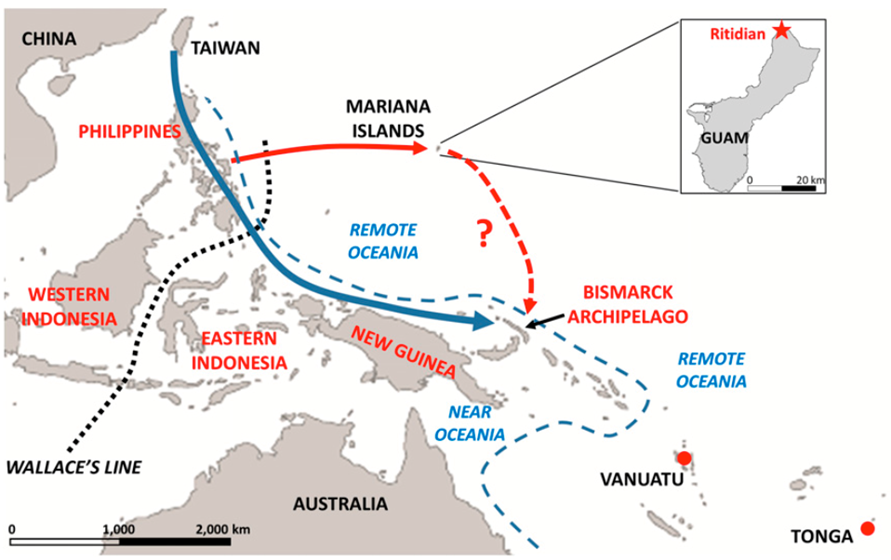
Figure 1. Streams of migration into Micronesia (Irina Pugacha, Alexander Hübnera,b, Hsiao-chun Hungc, Matthias Meyera, Mike T. Carsond,1, and Mark Stoneking.) (Courtesy of M. Carson.)
Migration from the northern Philippines to the Marianas would have represented the longest ocean voyage made up to that time–a sea journey over the open ocean of about 1,200 miles without any stopover islands on the way (Rainbird, 2004). This voyage would have been in the face of the prevailing winds but assisted by the Kurashio Current. It would have resulted in the first settlement in that broad Pacific expanse that is known as Remote Oceania.
The assumption is that this first settlement was made not just by way of a single voyage, but through repeated contact over the early years. Evidence of settlement of shoreline villages was found on Saipan, Tinian, and Guam. The sea people who arrived in the Marianas settled along the shoreline, lived in wooden houses mounted on stilts, and depended heavily on shellfish, pelagic fish species, and other maritime resources for food. They possessed elaborately decorated pottery, shell and stone tools, and various types of ornaments that were worn by the living and buried with the dead, as has been found in later prehistoric burial sites (e.g., Carson, 2014).
These first settlers in the Marianas, the sea people who initially hugged the coastline of the islands they settled, brought the original cultural elements to their new home. These cultural elements would be greatly modified over the centuries, of course, and there would be other, much later visits from elsewhere. Especially consequential was the influx of another wave of settlers just a thousand years ago who have become associated with the latte culture they developed in the Marianas. Even so, those initial settlers 2,500 years earlier represented an early type of seafarer society and lifestyle–one that became foundational in the islands–which they brought to the shores of the Marianas by way of the Philippines and island southeast Asia.
Early Castaways on European Ships
In the intervening centuries we have very few documented cases of Filipino castaways reaching the Marianas, although there is a record of a number of persons from other places washing up on those shores. Choco, a Chinese from Ternate who was in Guam when the first missionaries arrived, was one. There were also some Malabarese.
It is possible that a few Filipinos may have been on one or another of the Manila galleons that were wrecked off the Marianas; e.g., San Pablo in 1596, Santa Margarita in 1601, and Concepcion in 1639. A Franciscan priest and several soldiers from the San Pablo left the ship and lived ashore until the arrival of the galleon the following year. We know from the Friar Juan Pobre that the survivors of the Santa Margarita, wrecked off Rota, were distributed to various islands, and some may have remained after the priest was taken off by another ship seven months later. (For summaries of contacts and impacts, see Russell, 1998 and Barratt, 2003). A number of crewmen survived the wreck of the Concepcion off Tinian and spent some time in the Marianas. One of them, a Filipino by the name of Pedro Ximenez who had been on the island for 30 years, met the missionaries upon their arrival and soon afterwards had his two-year-old son baptized.[2] Two others, both of whom had lived in the Marianas for years, would offer special assistance to the leader of the first Christian mission in preparation for his evangelizing work in those islands.
Participants in the First Mission
Contact between the Philippines and the Marianas resumed with the arrival of the Jesuit priest Diego Luis de San Vitores in 1668 with the purpose of founding the first Catholic mission there. San Vitores, who had spent the previous six years engaged in missionary work in the Philippines, had already learned the basics of the Chamorro language through the services of two Filipinos who had lived as castaways in the Marianas for 20 years (Hung et al, 2011, 923; Russell, 1998, 75). Besides his five Spanish Jesuit companions, San Vitores brought 19 Filipinos as well as a dozen creoles from Mexico. These lay assistants were a significant presence in the Marianas at the threshold of its first continuing contact with the West. They accompanied San Vitores and the other priests, serving as catechists and as part of what San Vitores termed his Escuadrón Mariano, or “militia.” From the outset, San Vitores recognized that if the mission was to be effective, “others … must be added to our company by way of an escort, or better said, to serve as examples of Christian living, which is the only defense among these poor peoples.”
These catechists did more than accompany the priests to the villages, offering them protection and assistance in gathering the people for services. They often went about the island by themselves, instructing converts and teaching the children prayers and religious hymns. They baptized those in danger of death, especially infants, even when the rumor began circulating that the baptismal water poured on their heads was poisonous.
When violence erupted not long after the mission began, these catechists were among the first victims. In all, 26 of the original 31 catechists died a violent death during those early years. A few of these are named: Hippolito de la Cruz (+1670), Damian Bernal and Nicolas de Figueroa (+1671), and Pedro Calungsod (+1672). In the three months between December 1674 and February 1675 alone, seven Filipino assistants lost their lives (Hung, et al, 2011, p. 923; Russell, 1998, p. 75).
The original team of catechists was all but wiped out by the mid-1670s, victims of the intermittent fighting that broke out between the missionary party and those local people who had reason to resent the foreigners. The Filipinos and creoles, whom San Vitores designated his “militia,” were unable to protect him and themselves from a violent death; but they made a singular contribution to the founding of the church in the Marianas. These men who formed the Escuadrón Mariano and had given their lives in service to the mission were not replaced. Instead, Filipino catechists gave place to Filipino troops.
Filipino Troops
In 1675, just a year after the arrival of Damian Esplana, who would soon become their commander and then civilian governor of the new colony, the first soldiers came to reinforce the garrison (Garcia, 2004, p. 435). By this time the missionary compound and the Spanish center in Hagatna, the main village on Guam, had been surrounded by hostile Chamorro forces; a number of skirmishes had taken place throughout Guam and other islands in the Marianas; and two Jesuits and several mission helpers had been killed. The mission compound in Hagatna had subsequently been fortified with a wooden stockade to protect against further attacks. Clearly, in the eyes of the Spanish, the time had come to provide more than the nominal “militia” that San Vitores had gathered to assist him in his work. It was time for real troops, under the leadership of a trained Spanish commander with 20 years of military experience, to protect the gains that had been made (Hezel, 2015, p. 34).
If anything, violence in the islands only intensified over the next few years. As the military force moved around Guam in an effort to capture hostile ring leaders and open villages to the missionaries, new conflicts were bred and new cause for resentment was offered to those islanders already opposed to the Spanish. Within a two-year period, four more Jesuit priests were killed. In retaliation the troops marched on villages regarded as hostile and burned down houses and canoes. Soon island people sympathetic to the missionaries were taking it upon themselves to kill those regarded as rebels and present their heads to the Spanish (e.g., Hezel, 2015, p. 37-44).
Every year or two, the Spanish galleon would drop off new military troops to bolster the garrison: In 1675, 20 recruits; in 1676, 14; in 1678, 30; and in 1680, 20 Filipinos and an unspecified number from Mexico (Garcia, 2004: pages 435; 453; 479; and 497). By 1681 there were reportedly 115 soldiers in the Marianas. But the number of troops kept increasing, even as the local population fell off because of infectious disease brought to the islands by the Spanish. By 1698, the year that signaled the end of hostilities, the garrison numbered 160 troops (AGI Philipinas, 95, f27). The size of the garrison never grew much larger.
Most of the troops were probably recruits from Mexico, but some were undoubtedly from the Philippines. Indeed, we are told that there were three companies of troops in Guam, two of them “Spanish” troops (drawn mostly from Mexico), and one company from the Philippines (most likely Pampangos, who were the favorite recruits for soldiery in the Marianas). We may presume, then, that one-third of the total garrison was Filipino, between 50 and 60 (e.g., Fr. Bustillo’s 1668 letter, Levesque, 1992-2002).
These troops were a ragtag bunch, poorly paid since the yearly allotment provided for salaries for no more than 60 men. In effect, the soldiers were receiving only a third of the salary they should have been paid. But the early governors managed to bilk the men out of even this money. Many of the troops married local women, afterwards withdrawing from military service since they could not afford to support families on the little salary they received from the government (Hung et al., 2011; Russell, 1998).
The number of soldiers who married into Chamorro society increased over the years. According to Spanish reports, there were six married soldiers in 1677; but two decades later, by 1698, there were 60 married troops out of the total garrison of 160 men (Levesque, 1992-2002, p. 319). Although there is no breakdown of this number by ethnic origin, we can assume that 20 or 30 of these married soldiers were from the Philippines.
The retired soldiers who married local women would have quickly established themselves in their local communities–perhaps not in their wives’ own villages, as was the custom in the Marianas, but certainly in the growing and increasingly complex society of Hagatna, the capital of the colony. In time some of these former troops returned to the smaller villages, where they were named as alcaldes (mayors), tax collectors and overall enforcers of Spanish colonial policy in the village. They were given the responsibility of managing the Hacienda Real, or the royal land parcels that were designated for the use of the Crown in each of the villages. Village authority was meant to remain in the hands of the traditional chiefs, according to Spanish colonial law. But, more often than not, the Chamorros who should have held the chiefly title found that they were subject to so much local pressure that it was difficult to discharge these responsibilities effectively. Hence, foreigners were picked to do the work; and in many instances those foreigners were retired military from the Philippines (Hezel & Driver, 1988).
Measuring the Influence by Numbers
As the Filipinos – most of whom were once soldiers – married and settled into village society. Their number and influence grew over the years. In 1710, the year in which the first census was taken in the Marianas, 417 foreign-born persons were counted in the island group (Hung et al, 2011, p.923; Russell, 1998, p.75). Although not specified, the number of Filipinos might have numbered between 60 and 80. By 1727, the date of the next full census, the number of Filipinos might not have increased; but their relative influence did, if only because the total pop-ulation had dropped from 3,500 to 2,800 (Levesque, 1992-2002: 13 17-45).
The next census, taken in 1758, breaks out the population by ethnic group (Chamorro, Spanish, Filipino) for the first time. The figure for Filipinos is given as 431, a number that includes not just the foreign-born soldiers (about 100 males), but their wives and their descendants as well. This number compares with the other tallies: 504 “Spanish” (largely creoles from Mexico) and 1,776 Chamorros.[3] If we are to use this system of counting–and it represents a significant change from the traditional matrilineal way of reckoning–the Filipino segment of the population would have been 16 percent.
The size of what is called the Filipino population grew by the same standards over the decades and into the 19th century (Levesque, 1992-2002 (19), 347-367). In 1800, the 1,234 persons designated Filipinos represented 30 percent of the total population (4,060). By 1830, the Filipino percentage of the total population of 6.490 was 40 percent.
Thus, over a period of 70 years, the Filipino portion of the Marianas population grew from 16 percent to 40 percent of the whole. During the same period, the Spanish/mestizo percentage increased and held steady at about 20 percent; while the Chamorro share dropped from about 65 percent to 40 percent. Such figures were sometimes used by early 19th Century naval visitors to the Mariana Islands to demonstrate the loss of the pure-blooded Chamorro; but to expect to find a “pure” population in any island group after more than a century of intensive contact is fatuous. Instead, these figures reveal the effect of intermarriage, especially the percentage of the total population affected by it. The figures also provide a measure of the extent to which Filipinos had merged with the island population, blending with it rather than replacing it.
Dilemma of Development
What was Spain to do with the Marianas in view of the drastic reduction in the islands’ populations and their limited economic prospects? Francisco Medrano, one of the earlier governors, suggested that the populations of the Mariana Islands be transported to the Philippines where the people could receive better care at much less cost to the Crown. After all, any hope that the Marianas might serve as the gateway to the rest of the Pacific was being proven baseless. It was too small to count. It had no riches to speak of. It was unnecessary even as a reprovisioning stop for galleons (Hezel & Driver, 1988, 151). Madrano’s proposal to ship off the population elsewhere and close down the Marianas altogether met with loud opposition from the Jesuits and was never acted upon. Yet, the problem of the imbalance of costs and benefits of retaining the islands was unsolved.
From time to time the governors of the Marianas turned to the Philippines for help in making their island economy more productive. Filipinos were sought to help build a stronger economy–not by taking over production, but by modeling agricultural practices that could be adopted by Chamorros. Beginning in 1722, the governors would periodically write to Manila requesting that 100 Filipino families be brought to the Marianas, given land, and encouraged to help improve agricultural production; and so, turn around the economy. Finally, in 1748, the request was acted upon. The Filipino families were selected and set sail for the Marianas, but they never arrived. The ship sank and all aboard were lost. After this, the plan was quietly dropped once and for all (Hezel and Driver, 1988, p. 155).
Shift in Orientation
By the early 19th Century, the people of the Marianas found themselves pivoting even more sharply westward, due to the force of circumstances. Spain’s colonial empire was rapidly shrinking. With the independence movements among the former Spanish colonies in Latin America, the yearly galleon visit to Guam was discontinued in 1825. The yearly subsidy from Spain had been halted for several years even before that; and when the subsidy was restored, its amount was greatly reduced. With the termination of the galleon run – the annual event that had been celebrated in Guam for the last two and a half centuries – all Spanish contact with the Marianas would now go through the Philippines rather than Acapulco. This would remain true through the end of the century and the termination of Spanish rule (summarized by Rogers, 1995, p.86).
The ship traffic from the Philippines was limited, and there was no massive migration from those islands to the Marianas. The shift did, however, provide an opportunity to take stock of cultural similarities. Later historians such as Florentino Rodao (1998, pp. 31; 38) noted many cultural features shared at that time by the two island groups: The favorite pastime of cockfighting, the ubiquity of bolos or machetes, dress styles – especially among women, and the common custom of possessing two homes (one in town and the other a ranch).[3] The author also noted the similarities in political and organizational models, especially the unit known as the barangay in the Philippines (e.g., Rainbird, 2004, p. 85). The suggestion that these cultural features were direct imports into the Marianas from the Philippines during this era might have been dubious. But Rodao’s observations did underscore the shared features of the two groups – some of which were undoubtedly products of the Spanish colonization, while others may have been rooted in a far deeper past.
Temporary Guests
During the first half of the 19th Century, Guam entertained a steady flow of visitors from other parts of the worlds. There were beche-de-mer traders and whaleship visits even before the arrival of the copra traders later in the century. European naval explorers from different nations – especially France, Britain, and Russia – made their way to the Marianas during the same period. With the termination of the galleon run and the need to find other means of support, the Marianas could not remain as sealed off from the outside world as it had been during the previous century.
The Philippines, meanwhile, were beginning to reassess their colonial status and to rally support for the independence that nearly all of the Spanish colonies in Latin America had already attained. Throughout the world the clamor for national freedom was resonating. As the independence movement picked up in the Philippines, Spanish authorities seemed determined to hold on to what little remained of their global empire.
In 1858, the Governor of the Philippines, under royal order to establish a prison in the Marianas, sent 63 convicts to Guam to convert an old barracks building into a prison. The convicts were soon sent back to Manila, but the Marianas was to become a penal colony during the final decades of Spanish rule (Rogers, 2011, p. 95).
After the Cavite Mutiny of 1872, the avalanche started. Numerous Filipinos accused of siding with the leaders of the uprising were sentenced to exile and shipped to Guam. Over the next five years, 1,200 deportados landed in Guam; so many that some 500 had to be sent to Saipan for settlement. Since there was no prison large enough to contain this many men, and it would have been difficult for them to find a way off the island in any case, the deportados were allowed to live among the island people (Rogers, 2011, p. 96).
Most of the deportados were repatriated after the Spanish monarch pardoned them in 1876, but a small number of the military convicts from the Philippines remained on island upon completion of their sentences. As so many had done before them, they married local women and assimilated into the local Chamorro community. But they did not settle in quite as quietly as others had done in the past. Some shared with others their radical notions of “native rights.” Such ideas were put into action when, in 1884, the local militia assassinated the governor as the first step in a plan to free themselves from Spanish rule. This insurrection was put down quickly. Several members of the local militia were tried for the murder, with 31 sentenced to prison, while 4 others were executed for their roles in the assassination (Rogers, 1995, p.96).
Once again, in 1896, after another insurrection against the Spanish in the Philippines was put down, over a hundred of those involved in the uprising were banished to Guam. Many of them had spent time on the island before and were confident they could easily escape from the old barracks that served as the prison. When they tried, though, they were met by volley after volley of rifle fire from the local militia. In the end, 80 were killed and 40 more severely wounded in what was the worst instance of bloodshed in three centuries (Rogers, 1995, p. 100).
Even as Spain was surrendering its islands to the US after its defeat in the Spanish-American War, one last encounter was taking place between Chamorros and their Philippine neighbors. In 1899, the Macabebes-Pampangos troops, known for their loyalty to Spain, were sent to Saipan to pursue the Filipino revolutionaries who had remained in the Marianas after exile from their homeland. The several hundred troops never found the revolutionaries they were chasing, but they put an enormous strain on the resources of Saipan for the several months they remained on the island. The residents of Saipan must have been relieved when the force and their commander were obliged to leave the island as Germany assumed control of the Northern Marianas (Farrell, 2011, p. 321).
After the Exit of Spain
After the Spanish-American War, Spain was forced to surrender its colonies in the Philippines and the Mariana Islands as prizes of war; thus ending more than three centuries of colonial rule in the former, and over two centuries of rule in the latter. Guam was handed over to the US to become the newest in its recent acquisitions, nearly all of them acquired within the previous ten years.[4] The Northern Marianas, along with Spain’s colonies in the Caroline Islands, were sold to Germany for 25 million pesetas (Hezel, 1995, p. 95). In later years, the Northern Marianas would be passed on to Japan, and then to the US; both times as conquests of war. The end of the Spanish-American War, therefore, marked not just the conclusion of Spanish colonial rule in the Pacific but also the partition of the Marianas into two political entities. This split has lasted up to the present day.
Since the end of Spanish rule in the Philippines and the Marianas, the interaction between the two island groups has continued; but the US has replaced Spain as the intermediary between them. For a while, America continued the Spanish government’s practice of exiling Filipinos, especially political prisoners, to Guam. The most notable of these was Apolinario Mabini, who lived on Guam from 1901 to 1903 before returning to the Philippines. Others followed from time to time, along with a small number of laborers and skilled workers (Quan, 2010). All in all, however, the flow from the Philippines to Guam during the prewar years was modest, while it was nonexistent in the Northern Marianas (Underwood, 1973, Table 7 population figures, 33-34).
The real boom began at the end of World War II. Guam’s population doubled between 1945 and 1950 as US forces engaged in an island cleanup and expanded the island’s military bases. The Philippines, the major source of labor for this effort, sent 8,000 engineers and construction workers to Guam. The influx of workers from the Philippines was stemmed within a few years because of local protests against cheap foreign labor. However, it was not long before the flow from the Philippines resumed. Between 1970 and 1990, the number of migrants in Guam nearly doubled–from 37,000 to 70,000; so that by the end of that period, migrants outnumbered local islanders (Quan, 2010). Not all of these migrants were from the Philippines, of course, but many were.
Afterwards, the demand for skilled labor (such as accountants, tradesmen, doctors, and nurses) continued to grow as the island population exploded. This was true even as young Guamanians were leaving in large numbers to find work in the US. With the explosion of the new tourist industry and the opening of several new hotels in Guam and the Northern Marianas during the 1970s and 1980s, thousands were recruited from the Philippines to fill new positions. Today, the 50,000 Filipinos living on Guam make up about 30 percent of the total population (Rainbird, 2004, p. 85). This represents yet another population infusion into an island society that has absorbed Filipinos into its own population many times before.
The productive relationship between the Marianas and the Philippines persists right up to the present, despite the tensions that may surface from time to time in Guam and in the Northern Marianas toward the Philippines. The particular forms in which this relationship is manifested might change from one era to another. US military bases may be enlarged on Guam, depending on what happens to existing bases in the Philippines. The request for trained workers from the Philippines might shift from one skill set to another depending on the economic conditions and labor needs in the Marianas Islands. Yet, the intertwining between these former Spanish colonies persists.
Conclusion
The persistence of this interaction over time is due to more than simple geographical proximity. The cultural proximity between the two island groups – the Marianas and the Philippines – has also played an important, although generally unstated, part in this long relationship. In this article we have tried to explore the different dimensions of this relationship as it has played out over the centuries.
We have seen that the Marianas have been closely linked to the Philippines from the very beginning; that is, from the earliest settlement of the island group three and a half millennia ago. Soon after the Austronesian arrival in the Philippines, these seafarers set off to establish the first population in the Marianas as well as other places throughout southeast Asia. Hence, the culture, language, and genes of the two archipelagoes have been intimately related from the earliest times. Traces of the relationship can be readily detected in the social and cultural features of both places.
At the outset of the first intense contact between the Marianas and the West in the late 17th Century, people from the Philippines played a significant role in mediating and facilitating this encounter. Filipinos comprised about half of the mission team that accompanied the early Jesuits in the late 1600s while they established the church in the Marianas. As these catechists were killed off during the early hostile encounters with island forces, the military was expanded to protect the endangered mission. Eventually, many Filipinos – perhaps a hundred or so who had served in the military – married Chamorro women and settled into village life with their Chamorro wives. Thus, Filipinos were a strong presence at the very time that the people of the Marianas were just beginning to assimilate Spanish culture. We can assume, of course, that the interaction produced a social and cultural current in the opposite direction as well.
At other times during the latter 18th Century and early 19th Century, the governors of the Marianas turned to the Philippines for help in developing a viable model for agricultural production on the islands. This did not always produce the intended results, but still the size and influence of the Filipino segment of the Marianas population grew steadily throughout this period. By the middle of the 19th Century, Filipino-Chamorro marriages and their progeny accounted for nearly half of the island population. We can only assume that this would have had its own impact on the lifestyle of the local people.
Then, during the late 1800s, as the revolutionary spirit was growing in the Philippines, unprecedented numbers of Filipinos were being shipped to the Marianas as deportados. These deportations triggered some of the most notable incidents of that period, including a failed jail-break that resulted in more killings than the island had seen in two centuries. Most of those who had been exiled were permitted to return to the Philippines, but many others remained to settle on Guam and increase the Filipino presence there.
The last half of the 20th century has seen another major influx of Filipinos to Guam and the Northern Marianas to assist in the rebuilding of the islands after the war, to provide the labor needed for the rapid growth of the tourist industry, and to help the island rebuild after the frequent typhoons that have ravaged Guam and Saipan.
We can conclude, then, that this relationship between the Philippine and Mariana island groups, founded in very early genetic and cultural ties, was reinforced over time by the contacts between the two peoples. As we have seen, this was particularly visible in the Marianas, where at critical times during its post-contact history, people from the Philippines played an influential role in precipitating and mediating cultural forces. Yet, for all that, the Marianas has retained its cultural and linguistic distinctiveness. Despite the impact that Philippine society has had on the Marianas over the years, it has not eroded this distinctiveness. Then again, the relationship between the two island groups need not be highly visible today, if only because the ties between them are buried deep in the bloodstream.
References
AGI Filipinas (18 January 1698). Letter of the Archbishop of Manila to the King of Spain. AGI Filipinas, 95, f27.
Barratt, Glynn. (2003). The Chamorros of the Mariana Islands: Early European Records, 1521-1721. Occasional Historical Papers Series, No. 10. Saipan: Division of Historic Preservation.
Carson, Mike T. (2014). First Settlement of Remote Oceania: Earliest Sites in the Mariana Islands. New York: Springer.
Farrell, Don A. (2011). History of the Mariana Islands to Partition. Saipan: CNMI Public School System.
Freycinet, Louis de (1839). Voyage autour de monde… pendant les annees 1817, 1818, 1819, et 1820. Paris: Pillet Aine. Part 1: History; Vol 3.
Garcia, Francisco. (2004). The Life and Martyrdom of the Venerable Father Diego Luis de San Vitores. Translation edited by James A. McDonough, SJ. Guam: Micronesian Area Research Center, University of Guam.
Hezel, Francis X., and Marjorie Driver (1988). From Conquest to Colonization: Spain in the Mariana Islands 1690-1740, Journal of Pacific History, 23:2, 137-155.
Hezel, Francis X. (1995). Strangers in Their Own Land: A Century of Colonial Rule in the Caroline and Marshall Islands. Honolulu: University of Hawaii Press.
Hezel, Francis X. (2015). When Cultures Clash: Revisiting the ‘Spanish-Chamorro Wars. Saipan: Northern Marianas Humanities Council.
Hung, Hsiao-chun, et al, (2011). The First Settlement of Remote Oceania: The Philippines and the Marianas. Antiquity, 85, 909-926.
Lévesque, Rene. (1992-2002). History of Micronesia: A Collection of Source Documents, 20 vols. Québec: Lévesque Publications.
Pugach, I., Hubner, A., Hung, Hsiao-chun, Meyer, Matthas, Carson, M. T. Ancient DNA from Guam and the peopling of the Pacific. (2021) PNAS, Vol. 118, No.1, e2022112118.
Quan, Clarisa G. (2010). Filipinos on Guam. Guampedia website. https://www.guampedia.com/filipinos-on-guam/
Rainbird, Paul. (2004). The Archaeology of Micronesia. Cambridge: Cambridge University Press.
Rodao, Florentino (1998). Pacific Islands: the Spanish Legacy. Madrid: Lunwerg.
Rogers, Robert F. (2011). Destiny’s Landfall: A History of Guam. Honolulu: University of Hawaii Press.
Russell, Scott. (1998). Tiempon I Manmofo’na: Ancient Chamorro Culture and History of the Northern Mariana Islands. Saipan: Division of Historic Preservation.
Underwood, Jane. (1973). Population History of Guam: Context of Microevolution, Micronesica 9(1): 11-44.
Viana, Augusto de. (2004a). Filipino Natives in the Seventeenth Century Marianas: Their Role in the Establishment of the Spanish Mission in the Islands, Micronesian Journal of the Humanities and the Social Sciences 3(1-2), 19-26.
Viana, Augusto de. (2004b). In the Far Islands: The Role of Natives from the Philippines in the Conquest, Colonization and Repopulation of the Mariana Islands, 1668-1903. Manila: University of Santo Tomas.
Notes
[1] Author contact: fxhezel@gmail,com
[2] In recent years, numerous publications have appeared on the archaeological work done in the Marianas and the conclusions derived from it. For an overview of this, see Carson, 2014.
[3] See AGI FIL 480; also in Lévesque 1992-2002: (14) 183ff.
[4] American Samoa would be added to the list of American colonies within a few years.