
MicSem Publications



Suicide in FSM: A New Direction
by Francis X. Hezel, SJ
2017 Suicide
Suicide, which has been the main cause of death among young males for some years, has been a real although sometimes unacknowledged threat to the Micronesian population for the past four decades. This problem area, one that the author and others have been researching and reporting on for forty years, appears to have taken another turn, according to the results of a recent survey of suicide in the Federated States of Micronesia (FSM). The research for the survey was funded by the FSM Department of Health Services through a grant awarded by SAMHSA. This article is an attempt to present the findings of this recent survey, link them to the previous work done on the subject, and present a suggestion or two on how research on Micronesian suicide might proceed in the future.
Suicide Epidemic in the Region
The 1960s was an exciting time for the Trust Territory of the Pacific, the islands in the western Pacific that the United States had administered since the end of World War II. With the US determination to jump-start the economy of the Trust Territory after years of stagnation, a new level of economic and social development at last seemed within reach. With the creation of the Congress of Micronesia, the scent of self-determination was fresh in the air. The time seemed full of promise for the islands that had been ruled by four colonial powers over the past three-quarters of a century. If there were any social concerns at all at that time, they may have been more focused on the growing problem that drinking presented now that consumption of alcohol by islanders had become legalized at the beginning of that decade.
By the early 1970’s, however, a sudden spike in suicide throughout the area captured the attention of many of us. The total number of suicides occurring in Micronesia (that is, Palau and the Marshalls in addition to what is now known as Federated States of Micronesia) leapt from 35 to 95 from the last half of the 1960’s (1966-1970) to the first half of the 1970’s (1971-1975) [Hezel 1989: Table 1]. The increase in the island groups that now comprise FSM was even more astounding; during those few years suicides skyrocketed from 17 to 60 [Table 2]. But the increase did not stop there. The number of FSM suicides continued to rise–to 166 during the 1970s, then to 233 during the 1980s, and on to 299 during the 1990s. In other parts of Micronesia, it might be noted, there was a corresponding increase during those same years.
The yearly suicide rate, which allows us to correct for population differences, reflects the sharp increase during those early years and shows that, despite a growing population in FSM throughout the 1980s and 1990s, the suicide rate maintained a constant high level of nearly 30 per hundred thousand people from 1980 until 2000 [Figure 1]. Micronesia’s suicide rate is strikingly high when compared with other parts of the world. The FSM suicide rate of 30, one maintained for 20 years, would have been the second highest of all countries in the world today, with only Guyana, at a current rate of 44.2, surpassing it. For the sake of comparison, US has a rate of 12.1, Japan 18.5, Germany 9.2, Thailand 11.4, Solomon Islands 10.6 , and Fiji 7.3 [WHO 2012].
Search for an Explanation
In the early years of this suicide explosion, a few of us started gathering data that we hoped would help us provide an explanation of why so many more Micronesians were now choosing to end their lives early.[1] As we pored through death certificates and interviewed families and friends, building a growing database on cases, we found a clear pattern in the suicides. The victims were overwhelmingly male; only 6 percent were women. They were nearly always rather young; 72 percent were below the age of 25, and half of them were still in their teens. In the vast majority (91 percent) of cases, the victim ended his life by hanging–usually by leaning into a noose and cutting off the oxygen supply causing the victim to slip into unconsciousness before he died of anoxia. The tight patterning of Micronesian suicide gave us further reason to believe that we were not witnessing a random outbreak.
Moreover, most of the deaths were reportedly occasioned by a tiff between the victim and his family. An earlier article on the subject offered a number of examples:
In one typical case, a 17-year old boy who had often complained that his family did not love him injured his younger brother in a fight and was severely scolded by his parents for this act. Not long after this he got drunk and hanged himself outside his house. Another young man from a different island was ordered by his father to work in the family garden even after he remonstrated that he had other plans that day. After the family had left to attend a community celebration, he dug up the garden and then hanged himself. An 18-year old from still another island group committed suicide shortly before his graduation when his request for money from his parents went unheeded. One young man in his early 20s, who is representative of many others, took his life when his family refused to allow his marriage to a girl with whom he had been living for almost two years and who had already borne him a child. Another young man hanged himself after a prolonged drinking bout following the discovery that he had been making sexual advances towards a girl in the household who was classified as his “sister.” Boys in their early teens have hanged themselves for similar reasons: one in anger at his mother for giving away a pet dog, another in shame and terror at injuring an uncle with a rock he had thrown, and a third for fear that he would be beaten for returning home late after watching video [Hezel 1989: 49].
Sometimes anger at a girlfriend or wife might trigger suicide, but more usually it was a rift (real or imagined) between a young man and his blood relatives. Given the cultural importance of age and the obligation of respect towards elders, the “offending party” was usually a parent, an older sibling, or occasionally an aunt or uncle. Younger brothers who did something to offend their older sibling could be dealt with more straightforwardly, by being scolded or beaten up.
Suicides in Micronesia, then, were expressions of anger or shame at close kin, often explosions of frustration at the perceived loosening of the bonds between the victim and his family. As an earlier article put it:
The dominant emotion at play in suicide, everywhere in Micronesia, is anger. Usually the victim takes his own life after he is denied a request, chastised or rebuffed in some way by parents or an older sibling. Inasmuch as Micronesian cultures place strong sanctions on the direct expression of negative feelings toward a parent or older authority, the offended party can choose either to suffer in silence or to act out his anger upon himself by suicide or such non-lethal means as cutting himself with a knife or refusing to eat for a time. Many of the suicides in recent years are of young men or women who, although acting impulsively, have nursed a grievance towards their family for months or even years. The imbroglio that precedes their death is often merely the latest, but decisive expression of tension between them and their families. Yet their act of self-destruction… is not a gesture of blind rage, much less defiant retaliation against the family; rather, it is seen by Micronesians as a poignant plea for understanding and reconciliation with the family. In a small minority of cases, perhaps 13% overall, the break in family ties is caused not by other members of the family, but by the victim himself, who is ashamed of something he has done to offend the family and fears the disruption in his relationship with the family that his action may cause [Hezel 1987: 284-5].
It was clear that, whatever the cause of the suicide epidemic in the islands, it could not be viewed through the same lens as Western suicides:
Even a cursory examination of the case data reveals that Micronesian suicides exhibit an etiology markedly different from that associated with suicide in the West. There is almost none of the chronic depression, the vague sense of meaningless of life, or even the despondency at failure in business or school that seems to play such a large part in suicides in other parts of the world. Micronesian suicides are manifestly interpersonal in nature, occasioned by what is perceived as a disruption in a significant relationship. [Hezel 1989: 49].
The importance of family for islanders was an ancient value, and ties with close kin had been cultivated and protected for centuries. What had happened to threaten these bonds–at least in the eyes of many young people–so suddenly in the late 1960s and throughout the next several years? Why had family relationships, long taken for granted, suddenly become so brittle? What was responsible for the sudden surge in suicide in Micronesia?
In his early writings on the subject, Don Rubinstein, cultural anthropologist and professor at University of Guam, wondered whether the loss of the men’s house might have been responsible for the suicide epidemic [Rubinstein 1983 & 1987]. The men’s house, in Rubinstein’s view, could be seen as a symbol of the collective care on which young lineage members could depend: other males in the family were around him for support, with the older men ready to mediate in the event of the very sort of family misunderstandings that seemed to be triggering suicides in recent years. While Rubinstein looked primarily at the decline of those institutions embedded in the lineage that once played a large part in the socialization of young islanders, my own writings pointed to the decline of the lineage itself and the loss of those who once functioned as mediators in family conflicts [Hezel 1987 & 1989]. For both of us the sociocultural changes in the family structure figure heavily in the rapid rise of suicide increase.
We had witnessed a surprisingly rapid breakdown of the lineage, which throughout the centuries had functioned as the family for islanders throughout the region. Even if the term “family” has always been a fluid one, it was increasingly being used from the 1960s on to designate the nuclear family–with mother, father and children, perhaps along with a few other relatives. In the new, more streamlined family today, a son could easily find himself in conflict with his father, or a younger brother at odds with an older brother, without the other older relatives who might have once intervened to resolve such disputes. Social organization of island culture at its most basic level was being redefined, and people were without those personal resources needed to mediate between individuals and reassure the young who might have had doubts on their status in the family.
What caused the revolutionary changes in social organization at the family level? Could it have been the sudden increase of US funding for the Trust Territory, a policy change that led to the creation of thousands of new jobs, rocketing employment among Micronesians, and the final surge of the cash economy to the tilting point. Now, for the first time, money flowed in sufficient quantity as to allow a significant number of wage-earners to feed their own families. They no longer had to rely on the land-based subsistence sector to survive. Cash inflow was no longer so limited as to serve as little more than a supplement to locally raised staples, providing occasional treats, Christmas presents and the like. For many cash was available in sufficient quantity to purchase the rice and canned fish or meat that one ate most days, and perhaps even to make a down payment on a second-hand automobile. The economic boom that began in the early 1960s was incontestable. Many of us argued that the ramping up of the cash economy was also responsible for the alteration of social organization and the breakdown of the lineage or extended family [Hezel 1989]. That, in turn, put young people face to face with those exercising authority over them, even as it stripped the functional family of those who had been most effective in mediating these disputes. The end result, at least as some of us viewed it, was the enormous spike in suicide that has occurred in recent years.
If the suicide spike is indeed a product of social changes in the islands, then the remedies are limited. Given the reluctance of islanders to share with others intimate details of their own family life, especially its negative side, it is highly unlikely that expanded counseling services were going to make a positive difference. Intervention on a case-by-case basis was impractical, and in any case the social factors responsible for the suicide increase would continue to endanger many more lives. The best we could hope for was that islanders and their families would adapt to the changes rather quickly. We could expect that the suicide rate might drop as islanders adjusted to the smaller form of family and the conflict that inevitably resulted, but this might take a generation or two to happen [Hezel 1991].
Recent Survey on FSM Suicides
A recent grant from the FSM Department of Health and Social Affairs allowed the author of this article to gather data on suicides that occurred in FSM during the period from 2007 through 2015. The collection of suicide data as part of this project would represent the completion of more than a half century’s data on suicide in FSM. The earlier material, a database on suicides from 1960 to 2006, was created by Micronesian Seminar, the church-based research and public education institute that the author directed for 39 years. The enlarged database that resulted from this project contains 1,051 suicides for FSM from 1960 through 2015 as well as several hundred records on Palau and the Marshall Islands. When added to the earlier data on the region, the information collected in the course of this project provides us with nearly complete documentation on a 55-year span, most of which represented a historically high suicide rate in the islands.
The methodology employed in earlier data collection was followed again for this project. All death certificates at the national and state levels were examined for any information on suicides. Accounts of suicides were then pulled from official death certificates and supplemented by personal inquiries in the local communities. The principal informants selected were normally those in the community who were close to the victim but who, as a rule, were not from the victim’s own family. The reason for the exclusion of close family members was that the information they furnished on the events leading up to the suicide was often unreliable due to their desire to protect the family’s interests.
Researchers worked from questionnaires nearly identical to those that had been used from the start in gathering suicide information. The entry for each suicide included as much biographical information as was available. The data gathered included birth rank in the family, level of educational achievement, employment status, history of alcohol and drug use, previous suicide attempts or warning, past family problems, details surrounding the death and probable motives for the act. Whenever possible, the research team tried to corroborate the information gathered with others from the community in which the suicide occurred.
Table 1 shows a tally of the suicides recorded in the recent survey, with the number and suicide rate broken down by state. The suicide data shown here is for FSM citizens who took their lives while residing somewhere in FSM; it does not include the many others who committed suicide in the US or on Guam.
Table 1: FSM suicides in FSM, 2007-2015, number and rate (per 100,000)
| Suicides (2007-2015) | Average per year | Rate (per 100,000) | |
| Chuuk | 104 | 11.6 | 23.2 |
| Pohnpei | 63 | 7 | 20.0 |
| Kosrae | 10 | 1.1 | 15.7 |
| Yap | 30 | 3.3 | 29.2 |
Findings in the Survey
Overall decline in suicide rate
The suicide rate in FSM, as indicated in the recent survey, has dropped significantly over the last fifteen years. The number of suicides dipped by about a third (from 149 to 100) during the first five years of this century, as Table 2 shows. Overall, the suicide rate has fallen from about 30 per hundred thousand, a rate that was nearly constant over a 25-year span, to about 22 today.
Table 2: FSM suicides in FSM, 1961-2015, number of suicides
| Chuuk | Pohnpei | Kosrae | Yap | Total | |
| 1961-1965 | 4 | 1 | 0 | 0 | 5 |
| 1966-1970 | 10 | 2 | 1 | 4 | 17 |
| 1971-1975 | 37 | 14 | 0 | 9 | 60 |
| 1976-1980 | 65 | 24 | 4 | 13 | 106 |
| 1981-1985 | 70 | 11 | 7 | 16 | 104 |
| 1986-1990 | 67 | 34 | 6 | 22 | 129 |
| 1991-1995 | 86 | 37 | 5 | 22 | 150 |
| 1996-2000 | 85 | 37 | 10 | 17 | 149 |
| 2001-2005 | 41 | 23 | 14 | 22 | 100 |
| 2006-2010 | 54 | 43 | 5 | 13 | 115 |
| 2011-2015 | 58 | 36 | 5 | 17 | 116 |
| Total | 577 | 262 | 57 | 155 | 1,051 |
Figure 1: Annual Suicide Rate (per 100,000) for FSM: 1966-2015 (final report 2016)
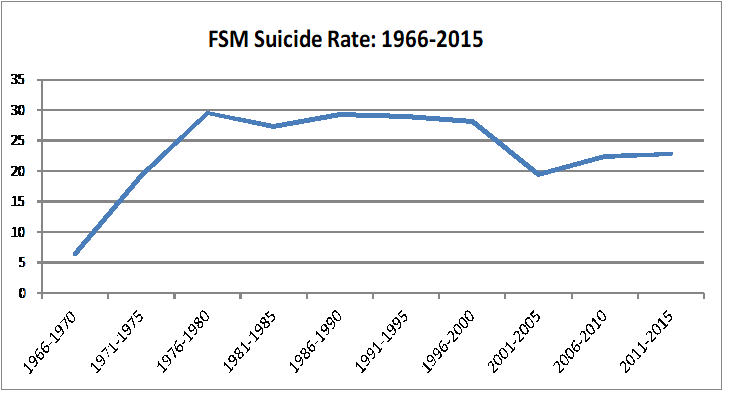
Each of the states shows a general downward trend despite considerable fluctuation over the entire period.
Table 3: Suicide Rates (per 100,000) for FSM by State: 1966-2015
| 1966-1970 | 1971-1975 | 1976-1980 | 1981-1985 | 1986-1990 | 1991-1995 | 1996-2000 | 2001-2005 | 2006-2010 | 2011-2015 | |
| Chuuk | 7.2 | 23.4 | 35.6 | 35.8 | 29.8 | 33.1 | 31.8 | 16.4 | 22.0 | 24.7 |
| Pohnpei | 2.5 | 14.6 | 21.3 | 9.6 | 25.2 | 22.7 | 21.8 | 13.1 | 23.9 | 19.5 |
| Kosrae | 6.3 | 0 | 17.0 | 24.6 | 18.2 | 13.9 | 27.0 | 40.0 | 14.9 | 15.4 |
| Yap | 11.8 | 23.1 | 32.1 | 37.6 | 45.4 | 40.0 | 30.4 | 39.3 | 23.0 | 30.1 |
| FSM | 6.4 | 19.2 | 29.5 | 27.3 | 29.3 | 28.9 | 28.1 | 19.4 | 22.3 | 22.8 |
Yap has had the highest overall rate of the states, peaking at 45 per hundred thousand in the late 1980’s. There has been a downward trend since the late 1980’s despite a spike in the beginning of this century, and the present rate is 30.Chuuk’s suicide rate peaked at over 35 in the period 1976-1985, and has tended slowly downward since then. Still, the figures show that Chuuk’s suicide rate has maintained the longest high plateau of any of the states. The rate reached 35 in the late 1970’s and remained between 30 and 35 until 2000 before dropping sharply to its present rate of 25.
Kosrae’s suicide rate hovered at about 20 for some years before peaking in 2001-2005 at 40, but fell sharply afterwards. During the years 1995-2005, its worst years, Kosrae with its small population of about 8,000 was experiencing two or three suicides a year. Its rate has been steady at 15 for the past ten years.
Pohnpei’s rate, one of the lowest in FSM throughout this period, maintained a plateau of between 20 and 25, although the rate dipped sharply at times. Its current rate is 20 per hundred thousand.
Increased numbers in some atolls
Although the suicide rate of Yap State has decreased in recent years, it appears that this is due to the drop in the number of suicides on the main island by ethnic Yapese. Indeed, suicides by those living on the Outer Islands are more numerous than ever; 57 percent, of the Yap suicides for the period 2007-2015 were from the coral atolls that account for just 37 percent of the state’s population. For the first time, suicides from the Outer Islands outnumbered suicides from the main island. During the period covered by the earlier data set (1960-2006), suicides from the Outer Islands accounted for just 17 percent of the total. Yet, the current suicide rate for Yap Outer Islands during this period, at 45 per hundred thousand, is higher than the rate for the entire state (30).
The suicide rates in more remote atolls in other parts of the nation vary, according to the results of the recent survey. The number of suicides, for instance, was high on Nama, one of the Mortlock Islands, but low in the rest of the Chuuk atolls. In Pohnpei the number of suicides associated with Pingelap–both on the atoll itself and in the Pingelapese settlements of Mwalok and Mand on Pohnpei itself–appears high. Yet, there was no corresponding increase detected in other remote atolls in Pohnpei State.
Through the 1980s, the rate of more remote and traditional island communities was significantly lower than other urban and peri-urban locations [Rubinstein 1983: 659]. In their analysis of suicide patterns, authors have ascribed this to the insulation of such places from the stronger effects of modernization, particularly its erosion of the traditional extended family. The sudden rise in the suicide rates in at least some of these atolls suggests that some of the impact of modernization on the social organization of atoll communities is already being felt. Thus, the atolls may already be less immune to suicide than ever before.
Shifts in gender and age
Suicide has been overwhelmingly a male phenomenon over the years, as the data in Table 4 reveal, but females vulnerability to suicide has been gradually increasing with time. During the years 1960-1999, females accounted for 61 of 701 suicides, or 8.7 percent of the total. In the last 15 years (2000-2015), women were the victims in 51 of 360 suicides, or 14.2 percent of the total. As the above table shows, females have accounted for an increasing percentage of the total. The female share has doubled over the years, from about 6 percent of all suicides during the 1960’s and 1970’s to nearly 13 percent over the last decade.
Table 4: Suicides by Gender, with Female Percentage of the Total, 1960-2015
| Males | Females | Female % | |
| 1960-1969 | 16 | 1 | 5.8 |
| 1970-1979 | 136 | 9 | 6.2 |
| 1980-1989 | 206 | 25 | 10.8 |
| 1990-1999 | 282 | 26 | 8.4 |
| 2000-2006 | 126 | 24 | 16 |
| 2007-2015 | 183 | 27 | 12.9 |
The low suicide rate among females has sometimes been ascribed to the fact that island women have a more secure place in the family than men. This would be especially true in the strong matrilineal societies of Chuuk and Pohnpei as well as in the Outer Islands of Yap.[2] Moreover, young women might be more inured to the inevitable clashes that occur with their parents, if only because they spend more time working with their mothers in the home than young men do with their fathers. Whatever the explanation for the low rate of female suicide in the past, it appears that female “immunity’ to suicide is weakening today.
The recent data collected on suicide also shows some changes from the tight age patterns that formally characterized Micronesian suicides in the past. The percentage of suicides among those aged 15 or below has dropped considerably–from 15 percent to 9 percent, as Table 5 indicates. The percentage of suicides in the 16-20 age cohort has also fallen–from 35 percent in earlier years to 28 percent in more recent years.
Table 5: Percentage of Total Suicides by Age Cohort
| Years | <15 | 16-20 | 21-25 | 26-30 | 31-35 | 36-40 | 41-50 | >50 | Unkn | Total |
| 1960-2006 | 15.3 | 35.6 | 21.5 | 11.1 | 5.0 | 3.0 | 3.9 | 3.3 | 1 | 100 |
| 2007-2015 | 9.5 | 28.1 | 23.3 | 14.3 | 6.7 | 6.7 | 3.8 | 3.3 | 4.3 | 100 |
Overall, suicides of teenagers, those in the two youngest age cohorts in Table 4, have dropped significantly over time. In earlier years this age group accounted for more than half (50.9 percent) of all suicides, but in recent years only 37.6 percent of all suicides have fallen into this age group. This is an encouraging trend because it suggests that the impulsiveness strongly associated with the suicides of younger victims might be less a factor today.
Recent suicide victims were not only older but also much more educated than those in the past, as Table 6 shows. In former years 25 percent of the victims never even finished elementary school; this has dropped to 17 percent in recent years. The gap is even greater for those victims who never went beyond completing elementary school: they comprised 21 percent of the suicides in earlier years compared to only 9 percent in recent years. Correspondingly, the more recent suicide victims showed a much higher completion rate for junior high school and senior high school: 24 percent and 22 percent compared with 11 percent and 15 percent in earlier years.
Table 6: Educational Attainment (by %) of Suicide Victims
| Highest education attainment | 1960-2006
(% of total) |
2007-2015
(% of total) |
| Elementary incomplete | 25 | 17 |
| Elementary school finished | 21 | 9 |
| Junior high school finished | 11 | 24 |
| High school finished | 15 | 22 |
| College finished | 3 | 5 |
| Info missing | 25 | 22 |
| Total | 100 | 100 |
Hints of a New Element: Focus on the Family
Suicide in FSM, as in other parts of Micronesia, is generally a response to a perceived disruption in a vital family relationship, as we have already noted. The recent suicide data gathered for this project suggest that the same is true today. The recent suicides included a young boy who was caught by a relative sniffing gas and was told that he would be reported to his parents, and a teenager who was found drunk and threatened with a beating the next day. There are many other instances in which young people were angry at measures their families had taken against them. In what could be described as a classical suicide, one young man got in a drunken argument with his older brother and hanged himself the same evening. A young boy, offended and angry when his mother turned off his game station in the middle of a contest, rushed out of the house and hanged himself. There are also one or two cases of suicide by young men who were frustrated when their parents refused their consent to marry the girl of their choice.
For the most part, these instances of suicide follow the traditional pattern. The incident leading up to the suicide, however insignificant it might appear, is viewed as the cause of the rift between the victim and his family. Even if the victim had a history of previous altercations with members of his family, the evidence suggested that this latest incident precipitated the suicide, if only because it confirmed in the eyes of the victim the broken bond between him and his family.
The reduced frequency of suicide among the very young, as we have seen, suggests that in recent suicides the element of impulsiveness, while never altogether absent, has been reduced. The individual choosing to take his (or increasingly her) own life may be subject to other forces–such as the familiar contagion effect of other recent suicides on the person–but he or she is still reacting to a personal crisis within the family. In earlier studies of Micronesia suicide, major emphasis was placed on the broken relationship between the victim and his family. The focus of these studies was the victim; relatively little attention was paid to the quality of family life itself. In the recent data set, however, the deficiencies in family life may have been better captured in the background information on victims. Even if what we might call family disruption can not be easily quantified, it appears to be both a critical and an understudied factor in island suicides.
Families with Multiple Suicides
One strong marker of family disruption is when more than one of the children in the family have taken their own lives. Even the older data set offers numerous instances of this. The most remarkable was a single family in Chuuk in which five brothers were reported to have taken their lives during the late 1980s and early 1990s.[3] About ten years later a distinguished family from Pohnpei lost two middle-age brothers and the son of one of them to suicide.
The earlier data (1960-2006) records 27 families in which at least two siblings committed suicide; in all but five of the cases the siblings shared both parents. In four of those same 27 families three siblings committed suicide. In one of the families with multiple suicides, even the mother and father are recorded as having attempted to take their own lives. The multiple suicides were distributed rather evenly throughout the time period covered by the early data set. In two cases the first suicide in the family occurred in the 1960s; in seven cases, it occurred in the 1970s; in nine cases it occurred in the 1980s. Three had their beginning in the 1990s, and six in the period 2000-2006.
The chronological proximity of the suicides within the families was not particularly close in most cases: generally there was an interval of at least three years, sometimes much longer, between the deaths. Some notable exceptions, however, can be found in the records. In the three of the families the interval between suicides was just one year; and in another three families it was even closer: the second suicide occurred in the same calendar year as the first. The concentration was most striking in one family that lost three young boys within a year and a half.
In the nine-year period (2007-2015) covered by the recent data set, there were similar findings. Eight families in FSM suffered the loss of at least two siblings to suicide, with one of these families experiencing three deaths. In general, the interval between the deaths of the siblings was shorter than was found in the earlier data. In two of the families the deaths occurred only a year apart, and in another two cases the interval was two years.
Clearly suicide is far more likely to occur in some families than in others. In this there appears to have been little change. We have just noted families in which there have been multiple suicides among siblings. This does not take into account the suicides of other members of the family group: parents in a few cases, uncles and aunts in many more, and other members of the broader family living in the household or close by. Past writings on the subject have examined suicide clustering as a phenomenon observed in islands or villages, but no study has been done of suicidal families in Micronesia. As the general rate of suicide in FSM slowly sinks, a few families seem to bear a greater share of the suicide burden in the islands. This topic might be profitably explored in future research.
Family Disruption
The background data gathered on suicides during the recent period (2007-2015) offers a few examples of family disruption and an understanding of how it might have played a part in the decision of the victims to take their own lives.
The split up of parents or the death of a parent can be a major cause of family disruption. This is true today notwithstanding the common practice of traditional adoption in the past, with the son or daughter shifting from natural parents to adoptive parents with relative ease. From the anthropological literature on adoption, one could get the impression that parental ties were of secondary importance to young people, inasmuch as they were expected to move within broader family circles freely.[4] There is abundant testimony to the easy circulation of young people in the past. To judge from the low suicide rates back then, adoption does not seem to have put young people at risk of suicide.
Yet, the background information on recent victims suggests that the death or departure of one or both parents may be a strong force in suicide today. In one family the death of a mother was soon followed by the suicide of two of her sons. When the father remarried, the sons sought out other family members with whom to live, but they frequently experienced problems with those they moved in with. Another young man took his own life after his mother abandoned his father to live with another man. The victim was reportedly ashamed at what his mother had done and bothered by the way in which his father responded to her departure. Another suicide victim, a few years later, was in a very similar situation when his mother left the family to marry another man. This victim, too, seems to have been motivated both by shame at his mother’s behavior and anger at his father’s reaction to the situation.
After suffering the loss of one or both parents, the children sometimes leave home and move around among other relatives. One woman, who had three children by different men, would not allow her offspring to stay with her after the man she married died. Accordingly, they moved off island to different places, taking whatever their father had left behind with them. Soon afterwards one of the sons took his own life. In a similar case, a woman who had just lost her husband disposed of her land and began traveling back and forth between islands. Faced with the disintegration of his family and the prospect of leaving home, one of the sons hanged himself.
In some cases, even when the parents remain married to one another, they or their children may be propelled for one reason or another into a nomadic lifestyle. One couple from two different islands spent much of their time traveling from one island to another, leaving their sons unattended as they moved around. Within a few years two of their sons committed suicide. In another case, the parents remained at home but the children shuttled from one relative to another, perhaps in search of the peace they could not find at home. One young man in this family eventually took his own life following an argument with his parents over his behavior.
Occasionally, young men and women who have left home–often to escape an unhappy home life–find themselves in the care of other relatives who may treat them even worse than their parents did. In one such case, a young man and his siblings went to live with an aunt who was not very well off and was seemingly unprepared to care for the young people who came to live with her. The young man committed suicide after he was scolded by one of his older siblings, but the act was no doubt conditioned by the difficulty he had been having with his aunt and his parents before that. In a different situation, a woman whose husband had just died was compelled to live with her husband’s parents, who took every opportunity to embarrass her. She soon died at her own hand.
FSM Suicides on Guam
As the survey of suicide in FSM was being conducted, the research team also gathered data on FSM people residing on Guam who committed suicide in recent years. The Government of Guam Vital Statistics Office provided anonymous data from death certificates that allowed us, through extensive interviews with Micronesian residents, to fill in the names and circumstances of those who had taken their own lives between 2003 and 2015. The average size of the migrant FSM population on Guam was about 13,000 during this period.[5] We hoped that the data gathered on Guam might provide an added dimension to the work being done on suicide in FSM, especially since no study of Micronesian suicide abroad had previously been done.
Table 7: Suicides of FSM People on Guam by State and Year
| Year | FSM | Chuuk | Pohnpei | Kosrae | Yap |
| 2003 | 5 | 4 | 1 | ||
| 2004 | 6 | 6 | |||
| 2005 | 11 | 8 | 1 | 1 | 1 |
| 2006 | 4 | 3 | 1 | ||
| 2007 | 9 | 9 | |||
| 2008 | 4 | 3 | 1 | ||
| 2009 | 13 | 12 | 1 | ||
| 2010 | 12 | 11 | 1 | ||
| 2011 | 3 | 3 | |||
| 2012 | 13 | 9 | 4 | ||
| 2013 | 10 | 8 | 1 | 1 | |
| 2014 | 6 | 6 | |||
| 2015 | 15 | 8 | 6 | 1 | |
| Total | 111 | 90 | 15 | 2 | 4 |
The number of FSM suicides on Guam for the period 2003-2015 totaled 111, as Table 7 shows, for an average of 8.5 a year. The number of suicides has been in double figures every year since 2009 except for two (2011 and 2014), while the suicide count for 2015 was 15 suicides, the highest number for a single year yet. Although most of the suicides by far (90 of 111) were of Chuukese, the latter made up 78% of the migrant FSM population on Guam. Hence, the Chuukese suicide rate was about the equivalent of that of FSM migrants from other states, notwithstanding Chuuk’s high numbers.
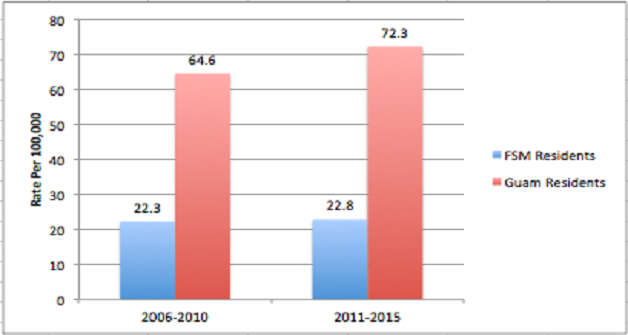
Assuming an FSM population of 13,000, the suicide rate for FSM people residing on Guam during the period 2003-2015 has been extremely high. As Figure 3 shows, the FSM suicide rate on Guam for 2006-2010 (64.6) was almost three times higher than the rate in FSM (22.3), and the difference was even greater in the most recent period, 2011-2015. The figures for suicide on Guam shown here are by far the highest yet recorded for the island population. The combined rate of 66 per hundred thousand for Guam during recent years is 50 percent higher than the peak of suicide in Yap (45) and double the suicide rate in Chuuk during its high years–from 1975 to 2000–when the rate was between 30 and 35 a year.
Figure 3:Suicide Rate for FSM People Residing in FSM and on Guam, 2006-2015
Gender and Age
Despite the much higher suicide rate among FSM people on Guam, the trends in suicide are very much in line with those we find in FSM: a slightly higher rate among females and a lower rate among the very young.
Of the 111 suicide victims on Guam during this period, 11 were females. Females represent 10 percent of the total number of suicides, a percentage that is line with the growing female share in Micronesia. The female percentage in suicide in FSM was close to 13 percent over the most recent five-year period, as we have seen in Table 4.
Table 8: Percentage of Recent Suicides in Select Age Cohorts: Guam and FSM
| <15 | 16-20 | 21-25 | 26-30 | 31-35 | 36-40 | |
| Guam
(2003-2015) |
5.4 | 23.4 | 31.5 | 17.1 | 11.7 | 6.3 |
| FSM
(2007-2015) |
9.5 | 28.1 | 23.3 | 14.3 | 6.7 | 6.7 |
As we have observed, the prevalence of suicide among the youngest age cohorts has dropped significantly in FSM over recent years. Although in the early data set for suicide in FSM covering the period 1960-2006 teens or preteens committed over half of all suicides, that percentage has fallen in FSM to 37.6 percent in recent years.[6] The percentage is even lower for FSM residents on Guam (28.8), suggesting that the impulsiveness characteristic of these young age groups is now playing a more modest role in suicide on Guam as it is throughout the islands.
Reasons for Suicide
At first glance, the events triggering suicide on Guam appear to be indistinguishable from those that would occasion suicide back in the FSM. The parents had strong objections to the girl that one young man wanted to marry. A young man had an automobile accident when drunk and ruined a car that his family had just purchased. A teenage girl was denied permission to go out with some friends, and a 16-year-old boy was not permitted by his parents to perform at a public dance contest. A young man was embarrassed at a scolding his mother gave him in the presence of his best friend. A man, ashamed of his arrest for public drunkenness, hanged himself in jail. A young man took his life after he was scolded by his relatives for speaking to his girlfriend too long on the phone. A girl was confronted by her uncle for sneaking out at night to see her boyfriend and was forbidden to do so in the future.
Yet, further investigation often reveals another dimension to the problem between the victim and his family–what has been earlier referred to as family disruption. The high incidence of suicide on Guam in recent years appears to have little to do with the financial struggles of migrant families, nor is it due to the belittling treatment that Micronesian migrants sometimes complain of receiving from local people on Guam. To gain a better understanding of this family disruption, we might look at those families with multiple suicides, as we did earlier in our review of the recent suicide data in FSM.
Families with Multiple Suicides
The data set of FSM suicides on Guam shows seven families with deaths of more than one sibling; two of these families lost three siblings to suicide. The concentration of suicide in certain families, because of the difference in size of the data sets, appears to be even a stronger element in Guam than it has been in FSM during recent years. (It should be noted that the number of suicides in FSM is 202, almost double the 111 suicides on Guam.) Besides those families that have suffered the deaths of two or three siblings, others have experienced multiple deaths of close relatives. One young man who hanged himself in 2010 lost two cousins to suicide just one months apart from one another and two months before his own death. Another young victim, aged 10, was reportedly the third person to take his own life in the house in which he had been living.
The two families on Guam that lost three siblings to suicide offer some hints on the kind of family disruption that might make young people more susceptible to suicide. In one family in which all three boys took their own lives, their father died when they were all quite young, leaving their mother to care for them on an island that was not home for the family. None of the boys received much schooling, and all went to work while still young in the struggle to provide for family needs. With very few close kin on the island, all three seem to have been sadly lacking in family support.
In the other family with three suicides, the parents split up against the strong desire of the children. Each of the boys in the family finished high school and was able to find a job, but their ardent hope to reconcile their separated parents was frustrated. Each of them attempted to bring their parents together and failed, with the suicide of each occurring soon after his failed attempt.
Family Disruption
Some of the most tragic cases of such disruption are those in which parents have split up against the desires of their children, as in the case described above. A ten-year-old boy, who had been living on Guam for just three years, watched his parents break up and then took his life seemingly in frustration. Another boy, who had also experienced the break up of his parents, was living with his mother and watched helplessly as his mother’s new boyfriend was preparing to drop her for another woman.
Other victims, because they did not have parents on Guam, were staying with other relatives. One was having problems with the shrewish aunt with whom he was staying. Another moved from one aunt to another, but apparently could not find peace with either of them. Yet another young man was said to have found little support from the aunt who was caring for him when his girlfriend left him. A Pohnpeian girl who took her life was staying with an uncle and his family and helping take care of the home when she experienced difficulties with the uncle. One young woman from a broken family moved from one house to another because of difficulties in getting along with her relatives.
In a few instances, the suicide victims fell in love with persons judged to be too closely related to them and they were denied the opportunity to marry them. This happened to one young man in 2013, and to another two years later. The most famous example of this was undoubtedly the Micronesian couple, first cousins of one another, who jumped off Two Lovers Point together, thus reenacting the tale that gave the landmark its name. It is easy to imagine that these young people might not have had the detailed schooling on just who their relatives were that they would have received back home, so they could unknowingly fall in love with a forbidden partner. In some cases, the mere fact that they were living with close relatives just outside their immediate family might have made it easier for them to disregard their blood bond. At any rate, the frustration of not being able to secure permission for such weddings presumably would have triggered the suicide.
Overall, there are strong suggestions in the Guam data, as in the recent FSM data, that circumstances in the family, even apart from those that might spark direct conflict between members of the family, may provide an environment that occasions suicide. As in the FSM data we have already reviewed, loss of one or both parents, moving back and forth between relatives, and custodial care by an unsympathetic relative without any fallback are all markers of the sort of family disruption that can result in suicide.
Conclusion
The pattern of Micronesian suicide that has emerged in earlier research has been largely confirmed in this study. Suicide remains preponderantly male, although slightly less so than in the past. The young remain at greatest risk, although the very young are resorting to this strategy less frequently than before; an increasing percentage of those who take their lives do so in their 20s and 30s. Suicide remains, as it has always been, a resort for those who feel that their bonds with family have been severely threatened or damaged beyond repair. The motives remain, as before, anger and shame prompted by something that either the victims or their close relatives have done to create a rift between them. In short, the basic dynamics of suicide along with its cultural meaning remain just what they have always been.
For several decades now the Micronesian family has clearly been undergoing a major transformation. The lineage group, whether based in a single residence or not, has been losing the privileged position it once enjoyed. The likely explanation for this shift is that the cash income which was becoming available to ever more islanders presented a challenge to the old land-based economy that was central to the way in which the lineage functioned. The effect of the cash economy was, at least in the judgment of some of us, to weaken the bonds that kept the lineage functioning as an economic and social unit. This traditional lineage, with its multiple parents and the strong role of the maternal uncle, reduced the authority role of the natural father and provided for a number of intermediaries in the event of conflict within the family. As the residential lineage unit lost its authority, however, the nuclear family achieved a degree of autonomy that it never enjoyed before. The authority of the father grew even as the nuclear family had to do without the senior family members who might serve as mediators in conflict. There may have been other forces at work in escalating suicide rates, but in all probability this was one of the strongest.
If the original explosion of Micronesian suicide rates that began in the late 1960’s was brought on by the breakdown of the extended Micronesian family, many of us hoped that islanders would eventually make the social adjustments needed to bring down the high suicide rate. The recent data on suicide in FSM presented here suggest that the rate is falling at last. We may yet see the suicide rate drop to what it had been before the economic and social upheaval in the islands.
At the same time, however, the suicide rate of Micronesian migrants to Guam has recently skyrocketed to a new high surpassing any of the peak rates in Micronesia itself. The juxtaposition of the declining rate in the islands and the escalation of suicide among Micronesian on Guam may be paradoxical, but it might suggest that hitherto unexplored forces are at play. Many of the recent victims on Guam appear to have come from incomplete families or damaged families. Is migration, if only because it denies vulnerable young people access to the support of family members they might have relied on back home, yet another contributing factor in suicide?
Often enough among the migrants who have been moving to Guam in large numbers, not even the nuclear family system is intact. Hence, migrants are often denied even the relatively frail support system, at least by comparison with the traditional lineage, that the nuclear family provided. It is no surprise, then, that young people who have migrated to Guam are often unable to find the support they need in the face of the additional stress that is an inevitable part of life abroad.
In view of the growing visibility of families with multiple suicides, suggesting that certain families are more troubled than others, this might be the time to explore family disruption even as we refine the concept itself. Such an effort would offer a new and potentially fruitful avenue of research in Micronesian suicide.
Francis X. Hezel, SJ
References
Gladwin, Thomas. 1953. “The Role of Man and Woman on Truk: A Problem in Personality and Culture.” Transactions of the New York Academy of Sciences, 15: 305-309.
Hezel, Francis X. 1976. “Tragic End for Troubled Youth.” Micronesian Reporter, 14 (4): 8-13.
Hezel, Francis X. 1984. “Cultural Patterns in Trukese Suicide.” Ethnology, 23 (3): 193-206.
Hezel, Francis X. 1985. “Trukese Suicide,” In Hezel et al, eds. Culture, Youth and Suicide in the Pacific: Paper from an East- West Center Conference. Working Papers, Pacific Islands Studies Program, University of Hawaii, Honolulu, 112-124.
Hezel, Francis X. 1987. “Truk Suicide Epidemic and Social Change.” Human Organization, 46: 283-96.
Hezel, Francis X. 1989. “Suicide and the Micronesian Family.” Contemporary Pacific, 1 (1): 43-74.
Hezel, Francis X. 1991. “What Can We Do to Prevent Suicide?” Micronesian Counselor, 5. Occasional bulletin of Micronesian Seminar. http://www.micsem.org/pubs/counselor/frames/prevsuifr.htm
Marshall, Mac. 1999. “‘Partial Connections’?: Kinship and Social Organization in Micronesia.” In Robert C. Kiste and Mac Marshall, eds, American Anthropology in Micronesia: An Assessment, 107-143. Honolulu: University of Hawaii Press.
Rubinstein, Donald H. 1982. “A Survey of Adolescent Suicide in Micronesia.” Pacific Health, 15: 2-5.
Rubinstein, Donald H. 1983. “Epidemic Suicide Among Micronesian Adolescents.” Social Science and Medicine, 17 (10): 657-665.
Rubinstein, Donald H. 1985. “Suicide in Micronesia.” In Hezel et al, eds. Culture, Youth and Suicide in the Pacific: Papers from an East-West Center Conference. Working Papers, Pacific Islands Studies Program, University of Hawaii, Honolulu, 88- 111.
Rubinstein, Donald H. 1987. “Cultural Patterns and Contagion: Epidemic Suicide Among Micronesian Youth,” In A. Robillard and A. Marsella eds. Contemporary Issues in Mental Health Research in the Pacific. Honolulu, 1987, 127-48.
World Health Organization (WHO). 2012. Suicide figures worldwide. https://en.wikipedia.org/wiki/List_of_countries_by_suicide_rat)
Notes
[1]. Donald Rubinstein, a cultural anthropologist who had recently completed his dissertation, and Geoff White, working at the East-West Center in Honolulu, both developed an early interest in Micronesian suicide. My own attempt to explore the suicide problem began in 1976 with the publication of an article “Tragic End to Troubled Youth.” Key publications on Micronesian suicide include Rubinstein 1982, 1983, 1985, 1987; and Hezel 1984, 1985, 1987 and 1989.
[2]. Thomas Gladwin, an anthropologist who worked in Chuuk for several years in the early post-war years, writes that he was forced to rethink his assumption “that the man is in a securely dominant position in the society” [Gladwin 1953: 307]. He is far from the only one to recognize belatedly the importance of women in island societies [Hezel 1987: 289].
[3]. Although informants in the community insist that five members of the family took their own lives, only three of the deaths are confirmed in the suicide database.
[4]. For a summary of anthropological thinking on adoption in Micronesia, see Marshall 1999.
[5]. In the survey of FSM migration on Guam completed in 2012 by Hezel and Levin, 13,558 FSM people were found to be living on the island. This can be compared to the migrant population of 9,098 recorded in 2003. Since the increase of the migrants was rapid and the present level achieved some years ago, we assumed an average population of about 13,000 over the course of the period 2003-2015.
[6]. The sum of the first two columns in Table 8 provides the total for preteens and teens.